AI adoption dominated the year. Whether that produced clarity about what comes next is a separate question — and the honest answer is mostly no.
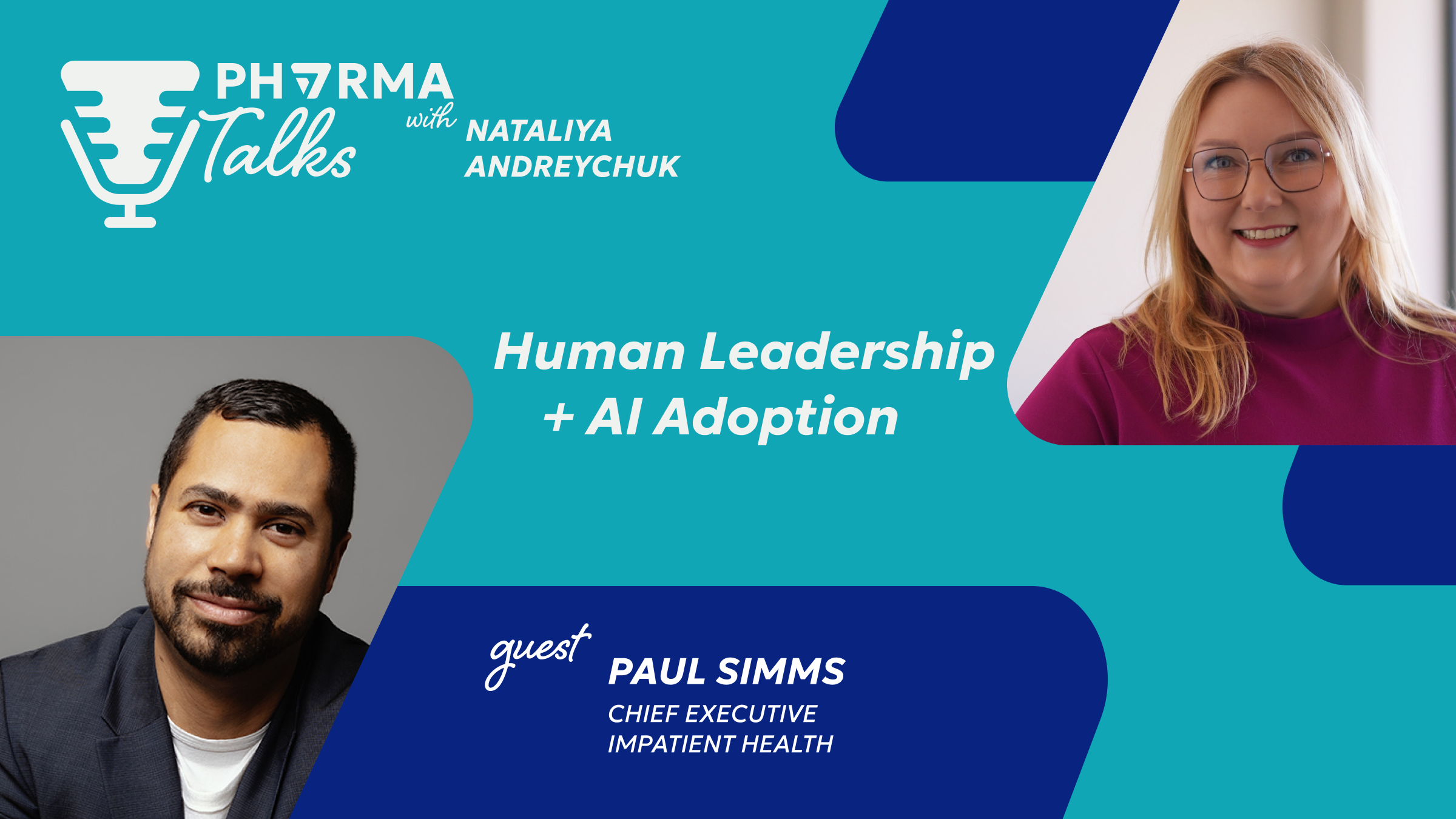
In this episode of Pharma Talks, Nataliya Andreychuk spoke with Paul Simms, CEO of Impatient Health, for a year-end reflection that turned into a set of arguments about where the industry is getting its own priorities backwards.
Change Isn’t the Threat
“If we had to summarize this year,” Paul said, “AI adoption in pharma would dominate the headlines” — alongside turmoil, rapid change, and disruption. Fear and opportunity in roughly equal measure, with very few people confident about what the industry looks like next.
His position on the fear: technological shifts have historically created more work than they destroyed. He acknowledges how that lands during a year of layoffs and talk of teams being replaced wholesale. Efficiency will always drive decisions in pharma. But “this is about human-in-the-loop, not human replacement,” and there’s a substantial list of things AI won’t do, at least not soon.
Nataliya’s response reframed the problem: pharma isn’t against change, it sometimes lacks the courage for it. Which led to the question that organizes the rest of the conversation — what has to break for the industry to actually evolve?
The Provocative Answer: Stop Asking Customers What They Want
Paul is deliberate about how this sounds in an industry that talks constantly about customer-centricity.
His case: most customers don’t know what they want beyond the short term, and struggle to articulate it even when they do. There’s a persistent gap between stated preference and actual behavior, with a long list of barriers distorting the feedback in between. Follow that input uncritically and you optimize for a horizon of months.
There’s a compounding problem. Everyone targets the same customers, so everyone arrives at the same answers. Right message, right place, right time matters — but so does being memorable and differentiated, and consensus research doesn’t produce either.
When I say we should stop listening to customers, I’m being intentionally provocative. Of course, we do listen. But listening alone is not enough. Leadership enablement also means anticipating needs, making bold decisions, and shaping the future rather than just reacting to it.
Idea First, Feedback Second
Paul’s read is that pharma marketers already have what they need — the people, the resources, the capability. What’s missing is initiative.
The operational change is a reordering. Rather than waiting for customers to set the agenda, develop a strong idea and take that to customers for reaction. Listening first feels safe and responsible. But durable development comes from presenting people with something they haven’t seen, which is also how relationships shift.
Nataliya added the vendor-side version of the constraint. By the time an RFP arrives, needs are already fixed in stone, and there’s little room left to propose anything different. She also noted that listening isn’t self-executing: people in the same meeting hearing the same words routinely leave with different interpretations.
Her framing of the harder part: it isn’t about asking customers what they want — that’s the comfortable step. It’s about trusting what you hear, and trusting yourself enough to propose something else.
Paul seized on the phrase. The industry is unusually harsh with itself, repeating that it’s bad at marketing and behind other sectors. “We beat ourselves with sticks, and unnecessarily so.”
Predictions as Statements of Intent
Asked for five predictions, Paul pushed back on the premise. Nobody knows the future, and prediction isn’t about accuracy.
Pharma has a strong preference for being right, which is precisely what blocks experimentation. “If you’re so worried about being right, you’ll never make a bold prediction.”
His sharper observation: the industry calls itself scientific but applies that rigor almost exclusively to drug discovery. The same experimental posture belongs in marketing, engagement strategy, and AI adoption — domains where being wrong is cheap and learning is the point.
Nataliya’s reframe made it usable: think of it as a 2026 manifesto. A statement of intent rather than a forecast.
Less Content, Two Kinds
Paul’s first prediction opens on a number: 77% of content produced today never gets used.
For years the industry has treated activity as value. “Nobody ever lost their job by making more content” — volume as the safe default. He argues it’s a vanity metric that has outlived its usefulness.
As on-demand and personalized production becomes standard, what counts as content changes. And customers now have AI of their own, which they’ll use to filter what reaches them.
That splits the requirement in two. Emotional, authentic storytelling built for humans. Clear, structured, machine-readable information built for the systems that will screen it. Doctors will increasingly rely on their own tools, and messages that aren’t concrete and precise won’t survive the filter.
Which raises a measurement problem Paul thinks the industry has been avoiding. Teams measure what’s easy rather than what matters. Relationships, trust, and quality resist quantification but decide outcomes. Technology should be producing new metrics — sentiment, connection, relevance — that capture what humans value alongside what machines require.
Compliance as a Skill, Not a Department
Paul’s prediction here is structural: compliance stops existing as a standalone function, without becoming any less vital.
The alternative is compliance embedded in how everyone works, supported by technology. His analogy is sport — a footballer doesn’t declare themselves finished learning the rules. “You can’t say you’re a good player if you don’t know the rules.” The same holds for anyone in a customer-facing role, and expertise in the rules is what enables innovation rather than what constrains it.
What he hopes to see by 2026 is compliance departments dismantled and the responsibility distributed.
Nataliya added the point that follows from it: pharma routinely cites compliance as the reason it lags on omnichannel and personalization. That explanation has worn out. It’s no longer a sufficient account of why the industry is less effective or creative than others.
Launch Like a Car, Not a Rocket
Pharma treats launches as rocket launches — everything perfect, every detail planned, no tolerance for deviation. When the wind changes, the whole thing fails and expectations collapse with it.
Paul’s alternative: drive instead. You know the destination. You don’t know the exact route. There’s traffic, there are detours, and none of that constitutes failure.
Nataliya found the metaphor calming next to how launches actually feel — rigid, overcomplicated, exhausting.
Paul extended it one step. Even with GPS running, the human keeps control. You can follow the route or ignore it. AI agents will make the driving easier; the decisions about how and when to use them stay yours. “The human still has the power.”
From AI-Obsessed to Human-Obsessed
Agility has stopped being optional, and the evolution required is cultural before it’s technological.
Paul’s argument is that the industry has spent enough time defining what AI will do and almost none defining what the human role becomes. Where are people most useful? Where do they create value nothing else can?
If we don’t put as much effort into defining the human role as we do into the technology, we’re ignoring our most powerful differentiator.
He expects the question to become unavoidable — individuals asking what their role is, what to invest in, what to let go. Over time the division clarifies: which applications belong to AI, which responsibilities stay human.
Will the Laid-Off Come Back?
Nataliya asked directly. Paul’s answer is qualified but leaning yes.
The common prediction is that agencies suffer most as technology absorbs their work. He disagrees. The companies that do well will be the ones that define the human role clearly — recognizing that technology is excellent at specific things and not at everything. Once the hype phase passes, the work becomes making AI genuinely useful.
He’s already seeing companies lay off and then rehire as reality lands. The recalibration is slow, but it’s underway.
Against Patient-Centricity
Paul’s most provocative position: saying you’re patient-centric may soon be a liability.
It sounds correct, in the same way “always listen to customers” sounds correct. But following what patients want or do without judgment carries risk. His alternative framing is science-centric. Patients don’t always know what’s best for them, and treating them as subjects to observe — “like zoo animals,” in his phrase — can do harm.
He grounds it personally. Diagnosed with diabetes during lockdown, he changed how he approached food, sleep, and habit, and felt the difference. When people stop mistreating their bodies, the change is perceptible. It starts with awareness.
Nataliya reframed it as closeness rather than control — the industry as a knowledgeable, empathetic partner that stays near patients and supplies reliable information.
Rapid-Fire
Nataliya closed with short prompts and no room to hedge. Paul mostly took the bait, though a few answers turned into arguments.
Will AI replace half of the MLR process? It has to, though it won’t be easy. Some companies are already moving.
Will LinkedIn outperform congresses? Depends on the definition. For information alone, LinkedIn wins. Congresses supply connection and inspiration, and appetite for face-to-face is rising, not falling.
Will printed materials disappear? Paul’s comparison is vinyl — technically inferior, still alive. The more digital things get, the stronger the pull of the tactile, including among younger people. They still watch Friends.
Will reps become orchestrators rather than messengers? It should already be true. He recalls a survey ten years ago where 90% agreed selling would no longer be a rep’s primary skill — partner, concierge, source of inspiration instead. Nataliya added that reps remain the most personalized channel there is: eye contact and language that lands is personalization in its original form.
Machine companionship? Concerning, particularly for young people still learning how human relationships work. Bots that replace real connection are a genuine risk.
TikTok for awareness and education? Yes — if not TikTok specifically, then short-form video. Younger generations find it more natural than email, and they’re becoming the mainstream customer.
Will patients directly influence brand strategy? Paul’s answer turns into a challenge. Misinformation circulates more freely than accurate information, and pharma frequently declines to engage with it, choosing short-term safety over long-term responsibility. As AI systems increasingly mediate search and discovery, that avoidance gets more expensive. If the industry won’t counter misinformation, the claim to be patient-focused doesn’t hold.
The through-line across an hour of predictions is that most of pharma’s stated priorities are pointed slightly wrong. Listening to customers substitutes for leading them. Patient-centricity substitutes for scientific judgment. Content volume substitutes for content that gets used. Compliance as a department substitutes for compliance as a competence everyone holds. In each case the industry has adopted the safe version of a good instinct.