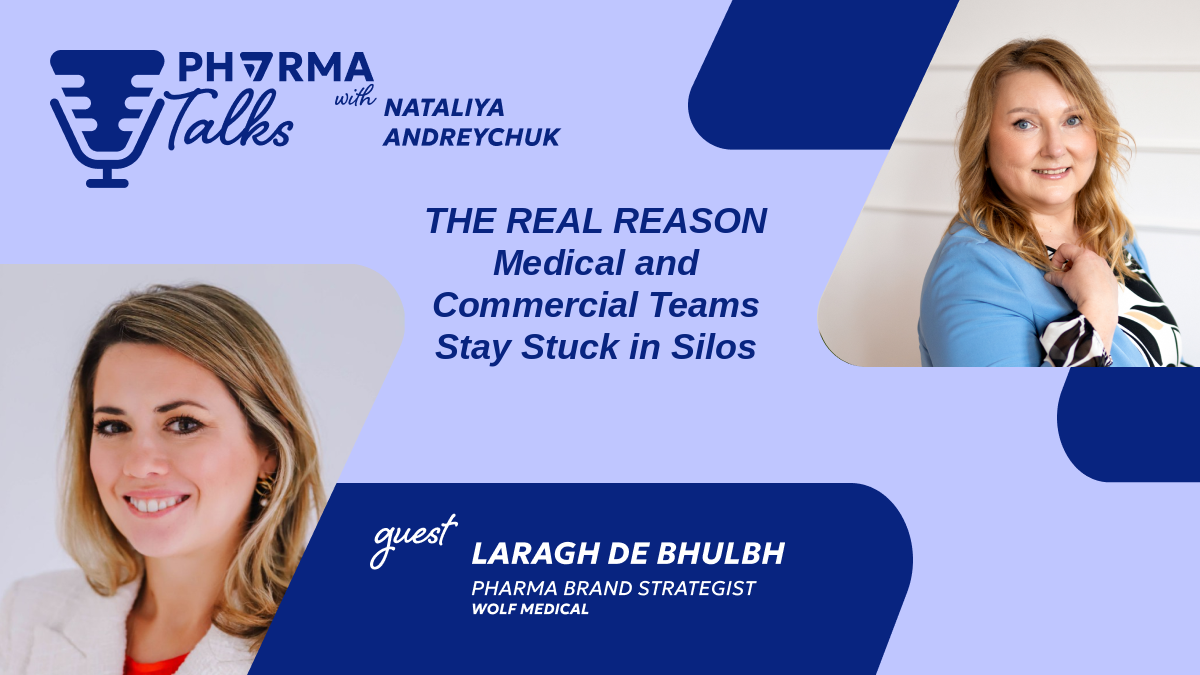
Medical Affairs is too often treated as the team you need sign-off from, not a partner you build with. On the latest episode of PharmaTalks, host Nataliya Andreychuk talks with Laragh De Bhulbh — leadership coach, strategy consultant, and longtime critic of silo thinking in pharma — about why cross-functional friction still drags down performance, even after 15 years of Medical Affairs evolving into a strategic function.
Medical Affairs Has Changed. Has Everyone Else?
McKinsey now places Medical Affairs alongside R&D and Commercial as a strategic pillar, not a support function. But structures haven’t caught up everywhere. As Laragh puts it, reviewing marketing materials isn’t the point — the real question is what the whole team is trying to achieve, and which function is best placed to drive which piece of it.
That division of labor shifts depending on the product and its lifecycle. Sometimes Medical needs to lead. Communication is what makes that flexibility possible: teams that break down silos move faster because everyone is working from the same picture, even when they disagree.
Where Teams Leave Value on the Table
Most leaders believe their teams collaborate well. They might — but “well” often has a lot of room to improve. Trust is the difference: when it exists, disagreement becomes a fast route to alignment instead of a stalling point.
Laragh’s litmus test: step back, ask what the team is actually trying to achieve, and match tasks to whoever has the right skills — not the traditional department. Disease awareness, usually a marketing job, sometimes belongs to Medical when the science is complex.
Data is the other blind spot. Teams build elaborate reporting pipelines, send insights up the chain, and then never revisit them. Trust changes that too — it’s what lets teams share failures as openly as wins, which is where the real learning happens.
The Fear Behind the Silos
Underneath the structural issues, Laragh points to fear: fear that Medical will reflexively block an idea, fear that Commercial will push too hard, and more personally, fear of asking a question that makes you look incompetent or challenging the room and damaging a relationship.
That fear breeds silence. People stop raising concerns, needs go unspoken, co-creation stalls. The fix starts with naming the cost of staying quiet, then agreeing on small, concrete steps forward together.
The CATALYST Framework
Laragh’s eight-pillar model for cross-functional performance:
Pillar
What it means
Clarity of purpose
Shared understanding of roles and goals across functions
Active collaboration
Communication that actually reaches the right people
Trust & empowerment
Genuine trust that lets teams act without waiting for permission
Adaptable strategies
Strategic thinking that responds to market shifts, not just tactical execution
Leadership alignment
Alignment even where Medical has no formal authority
Yielding results
Reconciling Medical’s multi-year timelines with Commercial’s monthly targets
Shared success
Treating each function’s win as the whole team’s win
Timely execution
Moving fast enough to act on opportunities that improve patient outcomes
Yielding results is the hardest pillar in practice: Medical’s impact shows up over years — shifting physician behavior, building disease understanding — while Sales and Marketing report monthly. Without agreement on what success looks like across those two timeframes, friction is baked in.
Medical Strategy Shouldn’t Copy Marketing — It Should Support It
Medical strategy isn’t a second version of the marketing plan. It’s the foundation commercial messaging stands on. That foundation matters most when things change fast — new trial data, a market shift — because trust and shared purpose are what let teams pivot without losing time to internal friction.
Rapid Fire: Hot or Not
Nataliya put a few pointed statements to Laragh:
Medical Affairs is now pharma’s most strategically important function. — Not.
Commercial silos are a leadership failure, not a structural one. — Hot.
You can’t fix cross-functional alignment without fixing incentives first. — Not.
Most strategic planning in pharma still happens in silos. — Hot.
Trust matters more than process for cross-functional work. — Very hot.
The best cross-functional leaders are willing to give up credit. — Very hot.
The Takeaway
Know what you’re aiming for, and say it out loud. Medical and Commercial need shared short- and long-term goals, honest exchange of perspective, and enough mutual trust that anyone can voice an idea without risk. That combination is what turns two functions into one team.
To Get Pharma Talks Episodes Straight To Your Inbox.
FAQ
What is Pharma Talks about?
Pharma Talks is a pharma podcast where industry leaders discuss life sciences, commercialization, tech adoption, digital transformation, and leadership.
Who are Pharma Talks for?
This pharma marketing podcast is for life sciences professionals, pharma leaders, marketers, medical teams, and innovators who want to grow and refuse to accept the industry status quo.
Who is the Pharma Talks host?
This pharmaceutical podcast is hosted by Nataliya Andreychuk, founder and CEO of Viseven, a global company that helps life sciences brands reach HCPs and patients faster with compliant and impactful content. She is also a LinkedIn voice in the industry, a member of the Forbes Agency Council, and a frequent speaker at industry events. Nataliya brings more than 20 years of experience in marketing and life sciences.
Can I become a guest at Pharma Talks?
If you have experience in pharma and life sciences or have founded a brand, platform, or media, you can apply to be a guest and share your story with our audience.