Pharma has spent years and substantial budget on producing more content. The question has moved: not how much can be produced, but how relevant, trusted, and timely it is when it arrives.
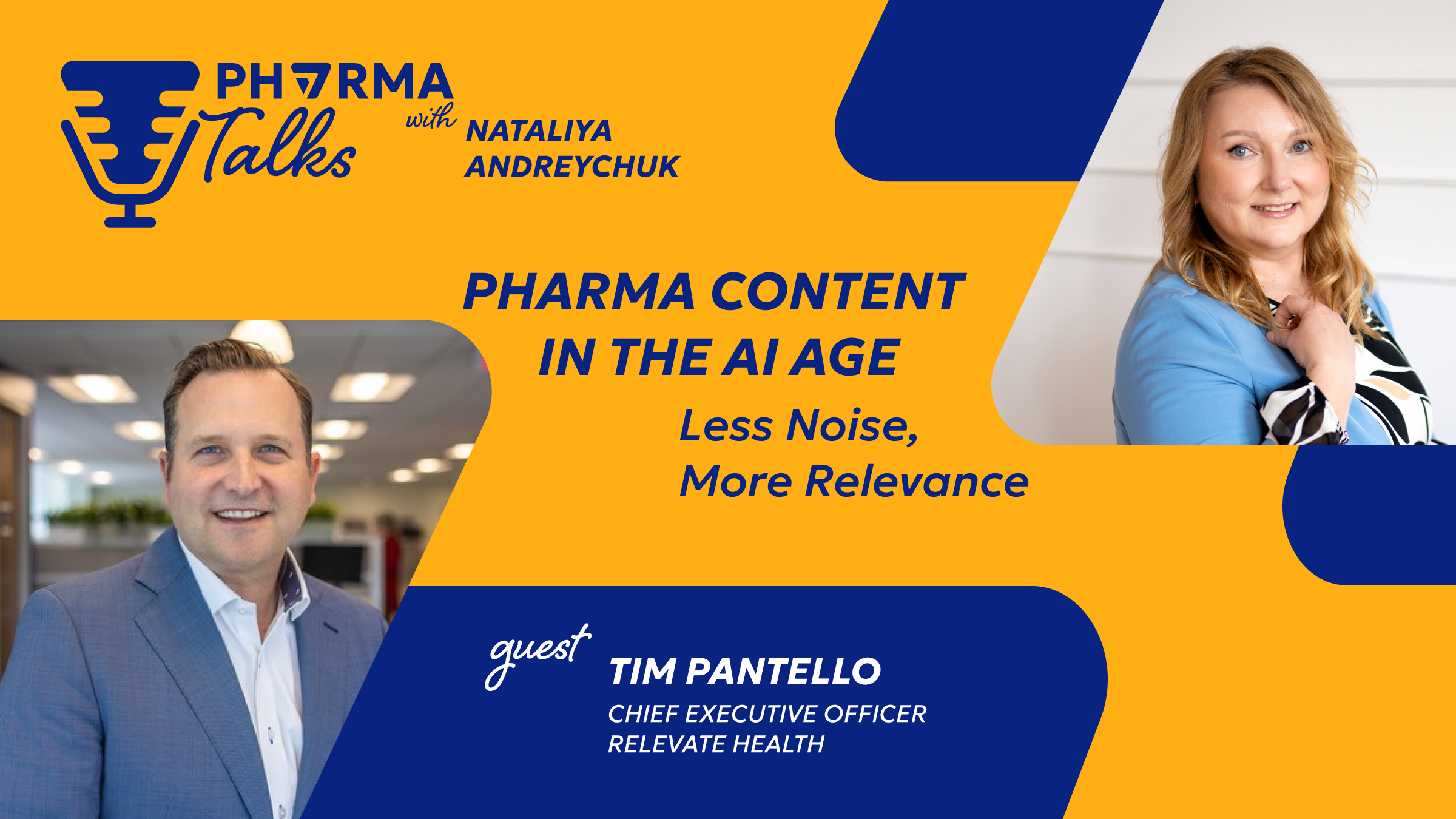
In this episode of Pharma Talks, Nataliya Andreychuk spoke with Tim Pantello, CEO of Relevate Health, about where that shift leaves content teams, agencies, and the relationships between them.
Why Tim Thinks This Period Is Different
Nearly three decades into a marketing career, Tim calls this one of the most interesting stretches he’s seen.
It’s not only about content development anymore. It’s about adding relevance to that content.
The capability is genuinely new. Organizations can reach HCPs and patients across more channels, anticipate needs faster, produce more efficiently, deploy across surfaces, and measure in ways that weren’t previously available.
What he’s careful about is what that capability is for. Mass production isn’t the objective. “Producing more pharmaceutical content is not the idea. What we are seeking is relevance.”
What Relevance Requires
Nataliya’s framing is that delivery power has outpaced the thinking about what gets delivered. Communication that stays one-directional or purely promotional doesn’t benefit from better infrastructure — it just arrives faster.
Tim’s answer to how you get relevance is signals, of which there are now more than ever. They can indicate when physicians are treating patients, which clinical moments carry weight, which channels are working, and when specific educational content is actually needed.
From Multichannel to Orchestration
The industry spent a long period on multichannel — many channels, little connection between them. The shift is toward orchestration, where each channel plays a connected role in one strategy rather than running its own.
Tim’s observation is that plenty of companies built strong martech stacks and customer data platforms without acquiring the ability to orchestrate against triggers, context, and local need. “That’s really the premise of omnichannel,” and the stack alone doesn’t deliver it.
Healthcare Is Local
Regions differ on healthcare systems, access levels, reimbursement models, and what treatment realistically looks like. HCPs consistently prefer hearing from regional or local clinical leaders over generic global messaging.
“They would much rather hear from local leaders,” Tim said. What’s changed is that AI and better tooling make that kind of intelligent localization scalable rather than aspirational.
He extends the same logic to search. Someone looking up diabetes gets thousands of results, which isn’t help. Generative systems can answer against a person’s actual condition, their stage in the disease journey, their specific concerns, and how much depth they want — moving both patients and professionals past generic retrieval.
Trust Doesn’t Get Automated
Scaling content operations doesn’t change what the content has to be. It still moves through approval processes, and it still has to be credible.
Information has to be trusted. You want it to come from credible sources.
Which reframes what AI is worth here. The value isn’t more content — it’s compliant content, faster.
The Misinformation Problem
Nataliya raised what sits underneath all of this. Evidence-based information often has a lower profile than influencer content that isn’t accurate, and the gap widens exactly when people are frightened about a diagnosis.
Her line on why: it’s easier to believe in something magical than to face a difficult truth.
That’s the argument for pharma companies, agencies, and technology partners building a stronger content supply chain together — so reliable information is discoverable and understandable at the moment someone is looking for it.
Hot or Not
Nataliya closed with rapid-fire predictions. Tim hedged on several, which turned out to be the interesting part.
AI-generated content will dominate healthcare marketing — Hot.
Pharma will finally produce less content, but better — 50/50. Some companies will keep producing more; what determines the outcome is whether it’s relevant and orchestrated. “It’s not only more. It’s whether it is relevant or not.”
Personalization will become the default expectation for HCP engagement — Hot. HCP expectations already shifted through their experience of the wider digital world. For Tim, personalization is another form of relevance.
Content teams will rely more on data scientists than copywriters — Maybe, but not in the way the statement suggests. “Maybe not necessarily data scientists. It may be more about inference through these engines and language models.” What he expects instead is prompt engineers and hybrid AI operators — people who can guide models, structure content operations, and work alongside the tools. “You’re going to have more prompt engineers than data scientists.”
Nataliya’s addition: “We will create environments where AI agents are treated like another team member.”
AI will fundamentally change how agencies support pharma — Already happening. The value exchange is being redefined now. Rather than producing assets and executing briefs, agencies have an opening to take a larger and different role built around strategy, orchestration, and measurable outcomes.
Nataliya’s qualifier on that: “We are still partners. Even with the new technology.”
Final Takeaway
The through-line is that better infrastructure raises the stakes on judgment rather than replacing it. More channels, faster production, and richer signals only produce better outcomes if someone is deciding what deserves to reach an HCP in the first place.
That’s also what makes the agency question genuinely open rather than threatening. The work being automated is execution; the work being created is orchestration and strategy. Which of those a partner is set up to do determines whether the shift reads as pressure or opportunity.