Pharma marketing has a resource problem: demand for content keeps climbing, quality standards don’t move, and the gap between the two has to be closed somehow.
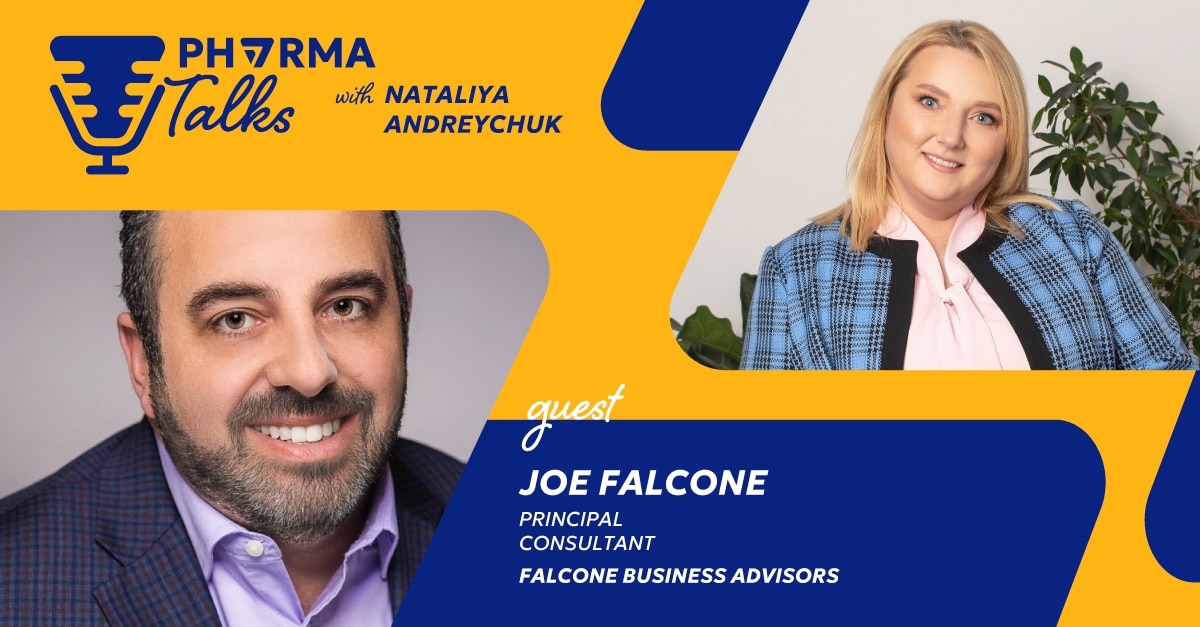
In the third episode of Pharma Talks, Viseven CEO Nataliya Andreychuk spoke with Joe Falcone about building a Center of Excellence that shortens time to market — and about why the teams chasing that goal most aggressively often miss it.
Two Halves of a CoE
Joe entered the digital agency world around 2008, just as digital was becoming a serious channel, and has since worked across enterprise, IT, and modular content strategy.
His framing: a Center of Excellence has two components. The first is production and change management — creative development, strategic planning, execution, workflow design. The second is excellence and oversight — governance, best practices, and pulling lessons from across markets.
The second half is where the overlooked details live. Channel standards, CX touchpoints, and HCP interaction patterns look minor when they’re scattered across functions, but they compound into real MLR efficiency effects.
Agency handoffs are the clearest example. Files arrive at a production agency 24 hours before launch with naming conventions that don’t match what the agency expects. Confusion, delay, and churn — at exactly the wrong moment. Small things, expensive consequences.
Standardization Isn’t Rigidity
A team that owns process standards ends up better at serving local and regional markets, not worse. The alternative — every market improvising — isn’t flexibility, it’s fragmentation.
Joe’s stronger claim: you cannot outsource excellence. The team has to be internal, because understanding organizational culture is the job. A real CoE knows how to engage internal teams, clear roadblocks across the content lifecycle, and carry lessons between markets.
Efficiency Is the Wrong Target
Both speakers landed hard on this. If efficiency is the primary goal, the initiative is being run for the wrong reason.
Focus instead on the experience delivered to internal stakeholders and customers, and cost savings tend to follow. Start every day asking how to shave a few dollars off an email, and the bigger picture disappears.
Measuring What Isn’t Obviously Measurable
Not everything is easy to quantify. Much of it comes down to agreeing what you actually want to measure and building the mechanism to collect it.
In his IT years, Joe managed digital roadmaps and built business cases for multimillion-dollar investments — which meant justifying ROI and defining how it would be measured. Sometimes the method was as low-tech as stakeholder interviews. On the customer side: ad boards with HCPs, industry surveys, direct conversations about whether the experience actually improved.
Nataliya’s addition was about ownership. Having the technical setup to track your own data, own it outright, and monitor it continuously is what makes any of the rest meaningful.
What a CoE Actually Does for the Organization
It preserves knowledge. People move between brands, get promoted, leave. Institutional knowledge leaves with them. A CoE absorbs that, supports onboarding, and shortens the learning curve for whoever comes next.
It partners early. Working alongside omnichannel and brand teams during planning, the CoE helps frame the questions that matter: what are we trying to achieve with this brand, what does the competitive landscape look like, which capabilities can we use for personalization and channel selection. Teams focused hard on budget often don’t know how to work with capability teams — that’s the gap the CoE closes.
It moves insight in both directions. Local ambassadors surface what’s working on the ground; the CoE brings that back to enterprise level and evolves the global standard accordingly. That’s how consistency and flexibility coexist.
AI as Augmented, Not Artificial
Joe’s preferred reframe: augmented intelligence. AI as a partner rather than a replacement, with the real work being identification of the use cases where it makes a genuine difference. The pace of change means today’s answer may not survive the year.
One concrete application: an AI agent sitting at the center of the CoE, answering questions and guiding people through processes and documentation — a first line of support for anyone who comes to the CoE for help. This doesn’t require enormous resources to stand up.
The second piece is training. Everyone, including junior team members, needs to know how to prompt and how to use these tools. A CoE without a training component leaves that capability uneven.
Nataliya’s point: standing up a CoE now generates the data that trains tomorrow’s tools. Experimenting early, while aligning to standardization and modular content goals, compounds.
Bottom Line
Progress over perfection. Starting and making mistakes beats waiting for conditions to be right — and if something is learned, it wasn’t a failure. Ask for help, stay inclusive, use the expertise around you. Define what success looks like and how you’ll know you’ve reached it.