Pharma content operations have outgrown the old model. More channels, more markets, more formats — and the bottleneck is no longer production capacity. It’s coordination.
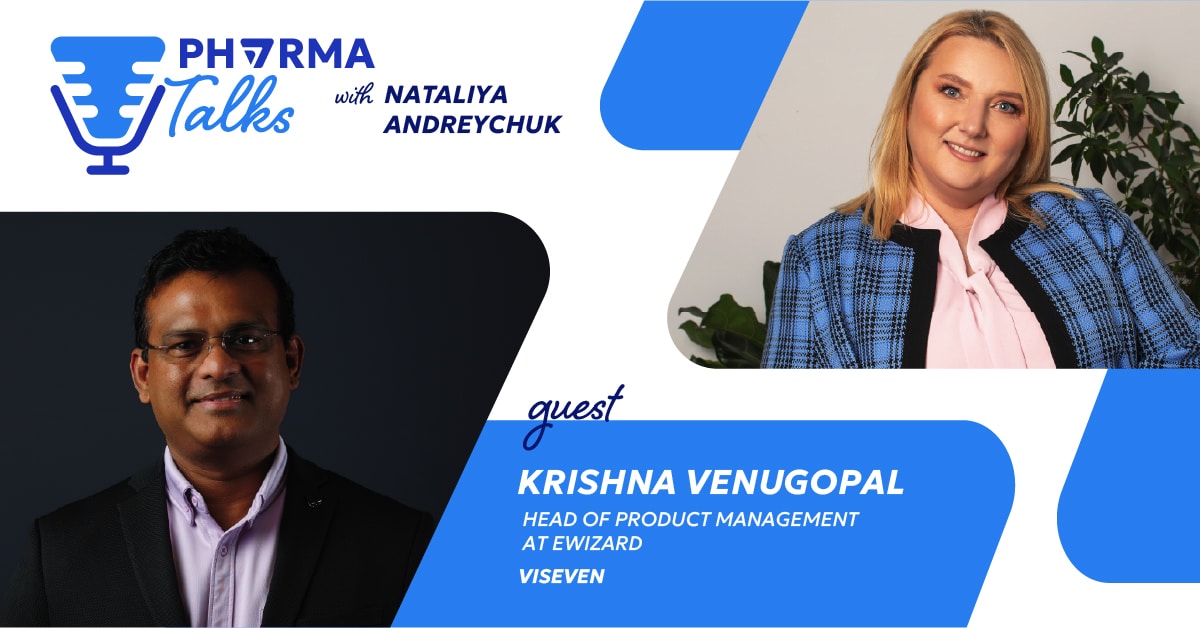
In the first episode of Pharma Talks, Viseven CEO Nataliya Andreychuk spoke with Krishna Venugopal, Product Manager at eWizard, about the structure that’s emerging as an answer: the AI-powered center of excellence.
From On-Premise to AI: How Expectations Shifted
Krishna has spent more than 15 years in CRM and CLM, watching the stack move from on-premise tools to cloud platforms to embedded AI. Each shift added capability — and raised the bar.
The audience changed too. HCPs and patients now carry social-media habits into every interaction: fast, seamless, indifferent to which platform they’re on. “From a user’s perspective, switching between platforms is just a continuation of the same experience,” Krishna noted. That puts the burden on marketers to hold consistency and personalization together across a fragmented ecosystem.
The Problem Isn’t Volume
Pharma doesn’t just need more content. It needs content that’s modular, reusable, compliant, and adaptable at the local level — which is a different problem entirely.
Nataliya recalled the era when large agencies produced at scale, typically siloed by channel or CRM. The rise of DIY tools, AI, and internal content factories has changed the question from how do we make more to how do we optimize the process. Krishna’s view: it isn’t DIY versus agencies versus AI. It’s knowing when each one is the right call.
What a Center of Excellence Actually Does
A CoE isn’t a team or a title. It’s a dedicated hub that brings people, tools, and processes under one umbrella — providing strategic oversight, technical guidance, and continuous improvement across content management, campaign orchestration, and market execution.
The practical payoff is adaptation. Global campaigns get localized properly — reworked for regulatory standards, audience expectations, and platform specifics, not just translated. In pharma, where regions often run different CRMs, a CoE means content can be built once and adapted many times without losing compliance or impact.
Global Vision, Local Ambassadors
“Think global, act local” survives because it’s still true. Both speakers pointed to data-driven decision frameworks with localization pathways built in — and to local champions who carry the global vision outward while feeding regional insight back.
Krishna framed it as two-way traffic: innovation doesn’t have to originate at the center. It can come from anywhere, provided there are open channels for ideas to be surfaced, tested, and scaled if they work.
AI as a Team Member, Not a Silver Bullet
Krishna described AI as “a peer who joins your meetings, offers ideas, and helps execute them faster and smarter.” The value isn’t replacement — it’s scaling output without proportionally scaling headcount.
“Think of AI as your assistant, your accelerator,” Nataliya added. Covering hundreds of markets becomes feasible, as long as human supervision and strategic direction stay in place.
Culture Decides Whether It Works
The harder part is cultural. “What’s your company’s definition of risk?” Krishna asked. “How do you treat failure?”
His case: treat the CoE like an internal R&D unit. “It’s where you test new approaches before scaling them. Just like in pharma drug development — you need a space for research, experimentation, and iteration.”
That requires trust, and an organization that treats learning as a result in its own right. AI is a tool. Whether it delivers depends on the structure and the freedom the people around it are given.