Data used to describe what already happened. The shift underway is toward data that shapes what happens next — and the organizational change that requires is larger than the technical one.
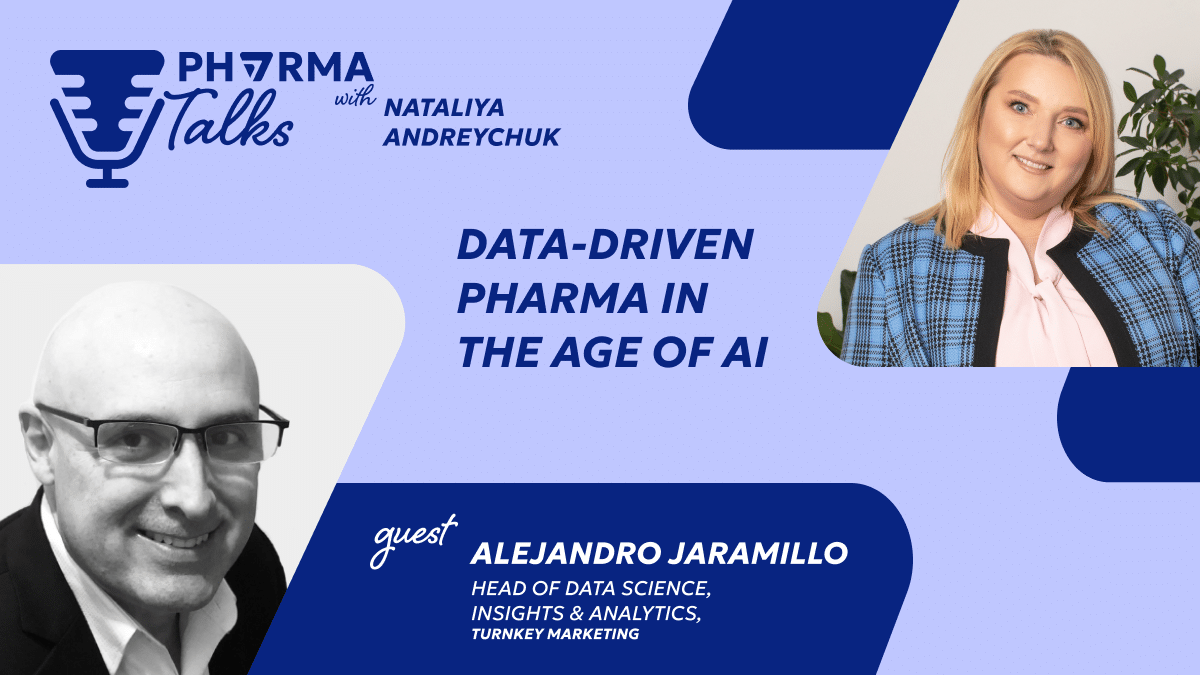
In this episode of Pharma Talks, Nataliya Andreychuk spoke with Alejandro Jaramillo, whose career spans data analytics, commercial strategy, and medical functions at Novartis, Johnson & Johnson, and Ipsen.
From Dashboards to Decisions
When Alejandro started in the field, most of the work looked backward — establishing what had happened and building relationships around that understanding. The current work is analytics driving strategy, which means predicting rather than explaining, and surfacing both opportunities and problems before they resolve themselves.
His framing: analytics as “a GPS for the business — helping on the journey of discovery.”
He’s careful about the novelty claim. Much of what gets called AI and machine learning builds on methods that already existed. What changed is scale and speed.
Nataliya’s extension of the metaphor is the practical one — everyone needs enough data fluency to be a skilled user of results. “We are all GPS users in the end.”
Value and Hype
“We work a lot with modular content and omnichannel journeys, and what I see is that AI in life sciences can bring huge value, but only when the business question is clear. It’s not magic,” Nataliya said.
Alejandro returned to GPS to make the same point. “With a GPS, we can go anywhere, find any location — it’s amazing. But it’s both a journey and a destination.” AI is a set of systems for processing information, reasoning, and deciding at scale — which means the value depends entirely on knowing what you’re trying to accomplish with it.
His formulation of the limit: AI won’t replace thinking, but it will change how thinking happens.
Where It’s Working, and Where It’s Risky
He points to biopharma applications in sales performance, prediction accuracy, and patient adherence, with further work in R&D, drug development, and clinical trial optimization.
The caution comes with it. “We sometimes expect perfect predictions, but we must remember the importance of compliance and data ethics, especially in pharma.” Patient privacy and regulatory adherence aren’t constraints to be optimized around.
His health equity example is the sharpest part of the conversation. A product performs well among patients with commercial insurance. AI identifies that group as most profitable and directs resources there. Populations with less access or lower adherence receive less attention — and the disparity widens, not through anyone’s decision, but through the system doing exactly what it was asked to do.
“That’s why we need human judgment,” he emphasized. “AI can help us find opportunities that were hard to see before, but we must stay focused on delivering value across the entire patient population.”
Personalization Starts With People
It’s hard to have a single recipe, but you’re touching on something essential. Too often when people talk about AI, they immediately think of software, data, and infrastructure — and forget about the human element.
“That human piece is actually where personalization begins,” Alejandro said. His test is whether the system is designed around the people it serves — patients, HCPs, or the reps who have a few minutes with a physician and need what they bring into that room to be relevant.
He frames it as more than strategic advantage: “It’s part of our moral clarity, and AI helps us simplify these decisions.” Everyone processes information differently, and AI can help simulate behavior and prepare field teams for those brief, high-stakes conversations.
Nataliya’s summary is worth keeping: “Personalization doesn’t mean creating a hundred versions of the same message. It means being smart about when and what we deliver to healthcare professionals.”
The Next Generation of Leaders
Nataliya’s view is that future leaders will pair empathy with analytics — emotional intelligence and data fluency as a single competency rather than two.
Alejandro’s version emphasizes comfort with analytics, tools, and cross-functional work. Data literacy doesn’t mean expertise in everything; it means understanding what AI and advanced analytics can do and where they stop, well enough to ask the right questions.
Sometimes leaders are so focused on implementing their own strategy that they stop listening. Even if we disagree, it’s important to understand where others are coming from — and to have the courage to say, ‘You’re right.’ Curiosity will be another defining trait. We may think AI has all the answers, but it still requires good judgment, understanding, and communication to drive a successful strategy.
Tomorrow’s leaders, in his framing, aren’t storytellers with data. They’re bridge builders — converting complexity into clarity and strategy into patient impact.
Nataliya named the specific problem they solve:
The new leadership role is transformational. It’s like being a translator. The biggest blocker today is language — marketing talks about brand, analytics talks about models, and sales talks about stories. We need translators, people who can connect the dots across silos.
Getting Functions to Work Together
Alignment across analytics, marketing, sales, and market access takes time and trust, and most teams default to their own priorities and their own data. “The real power comes from connecting all those pieces into one story.”
Each function has something to change. Marketing needs to move beyond measuring campaigns. Sales needs to look past short-term metrics. Analytics needs to translate rather than just produce. “Analytics should be the glue that connects these functions, and that glue is trust.”
It’s not enough to launch a campaign or build a model. You need to know the goals, the objectives, and how results — whether through traditional analytics or AI — will actually impact the business. Sometimes, it means challenging business partners and asking tougher questions about what data is meant to answer.
Nataliya’s addition is that becoming data-driven is a culture problem more than a technology one. “You can hire the smartest data scientists and buy the best platforms, but if teams don’t understand the technology or its impact, the value will be limited.” Transformation happens when data stops being specialist property and becomes shared.
Closing Thought
Alejandro’s advice to teams: learn the business, not just the technology. “It’s easy to get caught up in the hype of AI tools, but the real value lies in connecting technology to business problems and empowering organizations.”
That’s not solo work. “You can’t do it alone. You need to work with people who may not be familiar with the tech.” And it comes with a warning about which role to play: “Don’t be the person who only cares about numbers. Be the one who helps others get the most out of the technology.”
As generative tools, agents, and chatbots get easier to use, technical access stops being the differentiator. What’s left is the ability to connect data to the work people actually do.