Diagnostic algorithms trained primarily on male data miss conditions in women. That’s not a technical failure — it’s a record of who was in the room when the system was designed.
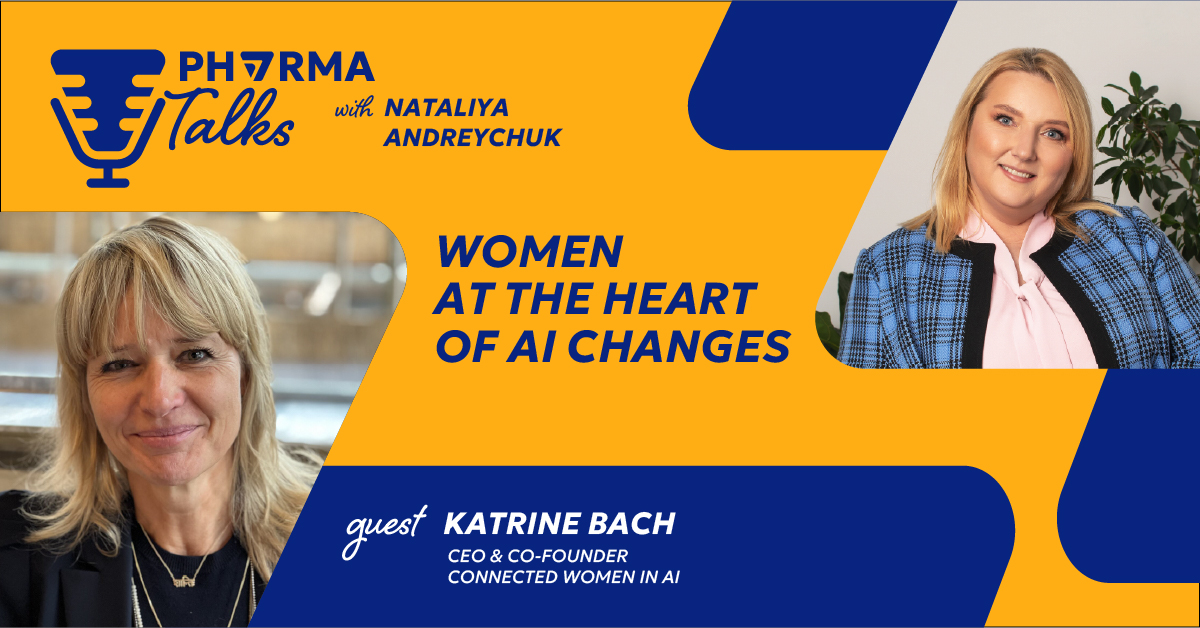
In the 13th episode of Pharma Talks, Viseven CEO Nataliya Andreychuk spoke with Katrine Bach, Co-founder and CEO of Connected Women in AI, about representation in AI development and why healthcare raises the stakes on getting it right.
From Anthill to Connected Women in AI
Katrine’s career has been rooted in pharma and healthcare, with decades spent on innovation in both. Her consistent emphasis: technical solutions only work when paired with human insight, collaboration, and trust — particularly in healthcare, where errors reach patients.
Her attention shifted toward AI and data analytics more recently, and what she finds compelling about this moment is its openness. Previous technological revolutions came and went without women fully represented in them. This one is still being shaped.
What Changes When Women Lead
Katrine is careful with the claim. “I’m not saying men don’t have them,” she clarified, “but women have the opportunity to bring qualities that can make innovation more successful.”
The qualities she means are less about technical capability than adoption. How do you bring people along? How do you build trust? How do you make AI part of a real workflow rather than a parallel system nobody uses? In healthcare, where the alternative to successful adoption is a tool that quietly fails, those questions decide outcomes.
Her longer-standing position is that diversity functions as a catalyst for added value and a competitive edge — and that without it, AI in healthcare won’t reach what it’s capable of.
Breadth as a Design Skill
Katrine’s view is that women tend to think across multiple tasks and adoption layers simultaneously, which adds depth to how innovation gets built.
She offered an analogy:
I read an article once asking, are you a good cook? My mom could cook twenty different dishes at the same time and still bring them all to the table perfectly. That’s a great example of why it’s so valuable to have women at the heart, in the center, of leadership and innovation — because we’re used to managing multiple tracks at once.
She resists naming individuals, though — mostly because of how often she hears the opposite claim. “I hear this so much,” she said of the “we can’t find any women speakers” line, “and I regret it deeply because there’s so much talent out there. That’s my mission — to make sure it’s seen.”
Pressed for one example, she pointed to Alejandra Betancourt at Novo Nordisk, who has taken technology on at its core and is driving how the company uses it to improve healthcare. “She’s a great role model,” Katrine said, “showing how a female leader can thrive in such a tech-centered position and really excel at it.”
The Concrete Risk
“When we talk about healthcare,” Katrine said, “it’s not just about efficiency — it’s about people’s lives.”
Absent representation in development, systems inherit blind spots. “Millions of people depend on these technologies,” she added, “and half of the population is women.” The diagnostic algorithm example isn’t hypothetical — models trained mainly on male data are already missing disease in women.
This isn’t a tech flaw. It’s a diversity flaw — because women weren’t there in the innovation and conception phases.
Building the Community
Katrine describes being “bitten by the AI bug” after stepping out of her CEO role — an epiphany that actually started earlier, when Anthill launched its first AI product. The pull kept returning after she’d left.
Connected Women in AI came out of that. The aim was participation, but also more than participation: women leading and shaping the technology, not being included in it.
“We’ve been running for ten months,” she said, “and we already have five thousand women in the community.” Most of that activity is concentrated in Denmark — a small country, as she notes, which makes the number more striking than it first appears.
The demand splits three ways: community and access to mentors and peers; capability, meaning resources and skill-building; and cultural and systemic change. This fall the team is launching an online membership program to meet international demand.
Don’t Wait for Permission
Asked what she most wanted listeners to take away, Katrine’s answer was direct: the future is being written now, and the female perspective is needed in it. Student, healthcare professional, leader, or man — the contribution is the same one, which is to engage, learn, and connect.
Her practical advice: find your community, and find upskilling opportunities built for you.
Nataliya closed on the same point. Confidence, capability, and shared knowledge are what open the door — and the industries on the other side of it are ready to receive women as experts.