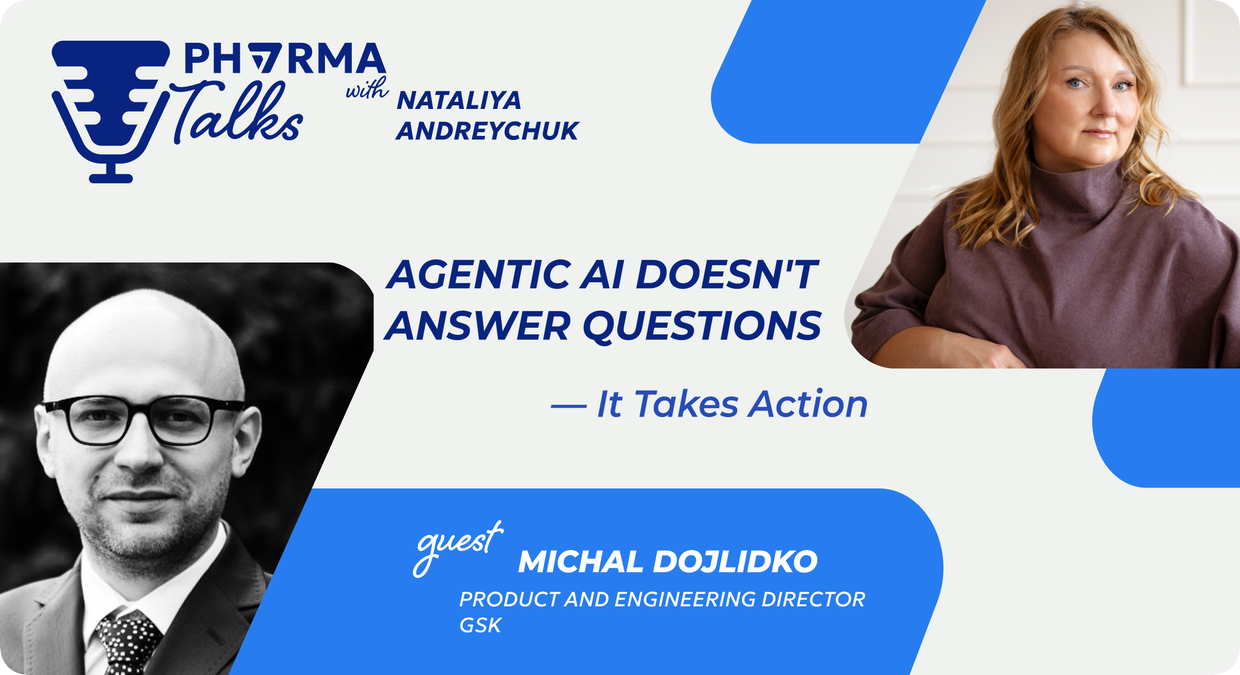
Generative AI produced better output. Agentic AI owns workflows and makes decisions inside them, which is a different governance problem entirely.
In this episode of Pharma Talks, Nataliya Andreychuk spoke with Michal Dojlidko, who has watched agentic systems move from concept to deployment inside pharma with a focus on running them safely at scale.
The Category Shift
Michal describes the last few years as breakthroughs arriving every few weeks. Generative AI began as a chat experience — drafting content, generating images, answering questions.
We moved from answering questions to AI being autonomous, taking care of processes and orchestrating workflows behind the scenes, from answering questions to taking action.
What that changes for pharma teams is the object of management. Output quality was the concern. Now it’s which workflows an agent owns and which decisions it’s permitted to make alone.
Treat It Like Workforce
Nataliya asked whether that means thinking about agents in terms of KPIs — as a role rather than a tool. Michal took the analogy further:
We could, and should, treat an AI agent like a regular workforce. Just like we have a development plan and objectives for employees, we need the same thing for AI: clear goals and boundaries. AI performs well when it has clear guardrails and objectives.
His larger point is about ambition. The instinct is to use agents to fine-tune how things already get done. He argues that wastes the capability — the opportunity is redesigning the workflow, not accelerating the existing one.
Trust Rests on Two Things
Nataliya raised the “magic wand” framing that many partners still bring to AI, which works directly against the trust the systems require. At enterprise scale that question compounds quickly.
Michal’s first non-negotiable:
When we set up AI for an agentic landscape, we have to make sure it has full traceability and auditability, and is compliant with all the regulations. That’s a guardrail we cannot breach.
The second, which he treats as the actual prerequisite:
Think of AI like a fast train. You cannot deploy a fast train on broken tracks — it won’t move fast. You have to sort the data first. Once you do that, AI and AI agents will work much more effectively on top of it.
Upskilling as a Process, Not an Event
Nataliya named the human obstacle: literacy. People can’t trust what they don’t understand, and part of the resistance is personal — the worry about being replaced by the system you’re being asked to adopt.
We need to make sure people are upskilled — not as a one-time, big-bang event, but continuously. AI evolves so fast that learning has to be an ongoing process.
He also warns against concentrating AI expertise in one team, which turns that team into a bottleneck. A central function can set standards — security, compliance, organizational approach — but everyone needs enough fluency to work with the tools and enough autonomy to make justified decisions inside safe boundaries.
The Scenario Marketers Describe
Nataliya relayed a vision from the Reuters Pharma US Forum: a marketer talking to an agent that understands intent, pulls current developments, builds segmentation, designs journeys per persona, and presents it back.
Michal’s response is that it already exists — just not at enterprise scale. The pattern he points to is a brand manager with a dedicated agent per digital campaign, and an orchestrator above them keeping campaigns aligned with each other and with the company’s overall message.
The technology isn’t the constraint. Introducing it securely into a corporate pharma environment is.
Guardrails Against Miscommunication
Nataliya pressed on “securely.” Speed and capability are both available; pharma handles information that reaches patients, which raises the stakes past what most industries face.
Michal’s answer has two parts. The technical one is an agent-as-judge model, where one agent evaluates another’s output. The one he considers essential:
Especially in highly regulated industries like pharma, we need a human in the loop. Imagine handing MLR review entirely to AI — that’s probably not the smartest idea. With humans holding the control button, the risk drops dramatically.
What’s Left for People
If agents are judging agents and absorbing operational work, Nataliya asked what remains — strategic decision-makers, or helpers to the system?
The dust hasn’t settled yet. If you thought there’d be less work, I don’t think that’s true. The volume of what’s happening in the world is only getting larger. Humans are still driving and setting the strategy and the goals — we need to make sure our AI companions are following the path we set.
His expectation is that repetitive, low-value work shifts to agents, which moves people toward creative and strategic work. That’s where the human advantage holds, at least for now.
Hot or Not
Agentic AI is a bigger shift than GenAI ever was — Hot. “We moved from asking questions to autonomous action. That’s a different category of change.”
Most pharma companies aren’t ready for this yet — Not. “The gap isn’t really readiness — it’s trust in our own people. Teams are already experimenting and keen to bring AI in.”
Pharma’s regulatory culture is an asset, not a barrier, for governing AI — Hot. “We have a real advantage here: years of experience setting proper guardrails. Less-regulated industries haven’t had to build that muscle.”
Companies that win invested in a data foundation three years ago — Hot. “We put a lot of focus on picking the right model and forget that even the best model needs the right foundation underneath it.”
Human oversight in regulated industries is non-negotiable — Hot. “We don’t really have a choice — regulation requires a human in the loop, and that’s not up for debate.”
The biggest risk is moving too slowly, not too fast — 50/50. The pace demands the courage to move, but moving without security baked in carries more risk than the upside justifies.
Final Words
The throughline is that agentic AI isn’t a faster GenAI. It’s a system that acts rather than answers, which means it has to be governed differently — clear objectives and boundaries, a data foundation in place before scaling, human oversight built into the regulated steps, and continuous upskilling so the people using it aren’t outpaced by it.
Michal’s priority is making sure teams have the skills to use what these systems can actually do. Nataliya’s addition: that means treating learning and change management with the same seriousness pharma already applies to compliance.