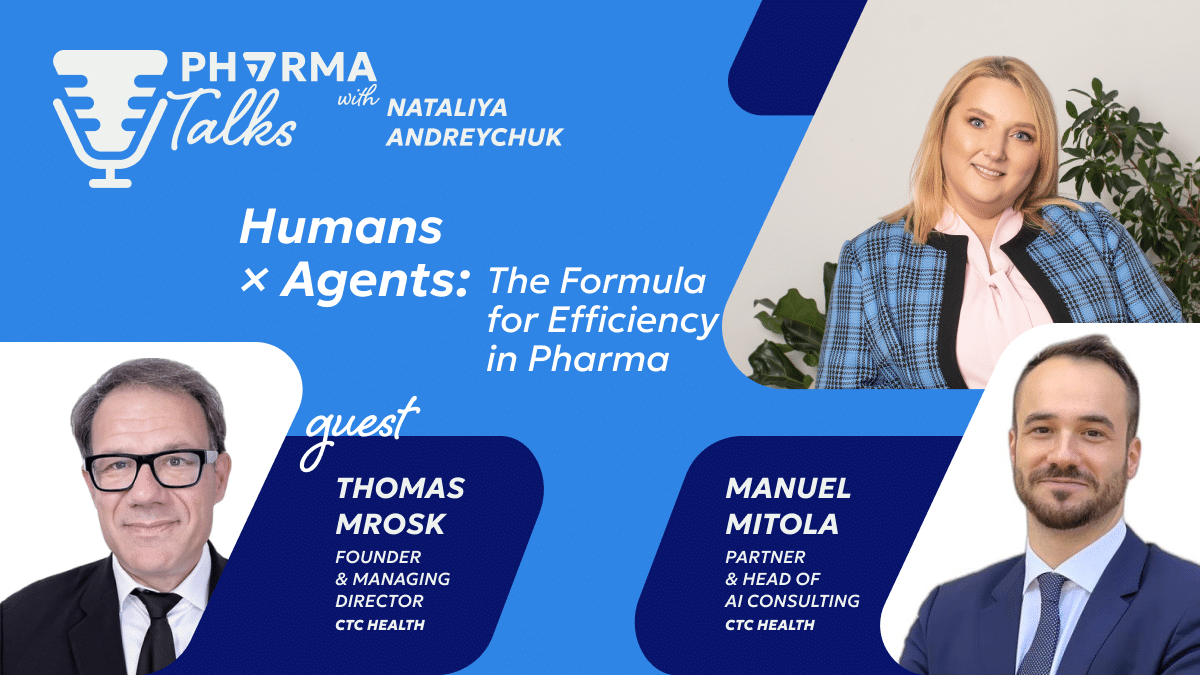
The fastest way to make an AI agent fail is to give it a job title. In this episode of Pharma Talks, Nataliya Andreychuk spoke with Thomas Mrosk and Manuel Mitola, founders of ctcHealth, about what actually works when agents enter regulated pharma workflows.
Start Small Enough to Learn From
“Look at the infrastructure you already have,” said Mrosk. The first question isn’t what an agent could do — it’s what’s missing and whether the new agent will integrate with what’s already running.
Companies frequently open with ambitions to overhaul entire workflows. The result is organizational strain and low adoption, which is a slower path than starting narrow.
“Apply a fail-fast philosophy,” added Mitola. “Run small pilots. Test if these experiences bring value. Then scale what works.” The target isn’t roles — it’s the mundane, repeatable tasks an agent can handle reliably.
A convincing demo makes it tempting to think in terms of replacement. But work in pharma marketing is layered, and the layers aren’t visible from outside the role.
“If you want to build an agent for a brand manager,” said Mitola, “don’t try to make it the brand manager. Focus on tasks the brand manager performs, like preparing parts of the brand plan or summarizing performance insights.”
Context Is the Requirement
Pharma doesn’t need another AI tool, Nataliya argued. It needs agents that understand context — brand templates, compliance rules, approved assets, and the data sitting in the DAM and CRM.
That’s not a nice-to-have in a regulated space. Context is what keeps output compliant and on-brand, and an agent operating without it produces work that has to be redone or, worse, doesn’t get caught.
Even with consistent output from a context-aware agent, humans remain in the loop. What the technology changes isn’t the need for oversight — it’s the silos between the people involved in producing content.
Two Concrete Applications
Field interaction capture. Manually logging every call into CRM is tedious and error-prone. “What if reps could just dictate what happened on the call?” Mrosk suggested. “The agent could structure it, ensure compliance, and push it to CRM.” Once that data accumulates, the agent can identify territory-level trends and suggest where to focus — next best action derived from actual interaction data rather than modeled assumptions.
Launch coordination. A brand launch isn’t one project; it’s dozens of interlocking tasks. “At ctcHealth, we see agents as an ecosystem,” said Mitola. “Each agent tackles a sub-task, so marketers get consistency in a way it collects and uses data.”
There’s a secondary effect worth noting: agents accumulate institutional intelligence. Practices that work in one affiliate become visible and repeatable elsewhere, which is something no individual has the vantage point to do manually.
Where Agents Still Fall Short
Domain expertise and human judgment remain outside what agents replace. Making one useful requires feeding it a real knowledge base and writing prompts that carry the necessary specificity — neither of which is a one-time setup cost.
The risks are hallucinations and compliance slips. Testing protocols, technical guardrails, and clear disclaimers reduce them; nothing eliminates them.
Which is the operating principle underneath the whole conversation. Contextual understanding makes an agent useful. A human in the loop is what makes it safe to deploy in a regulated environment. Agents don’t replace the people in pharma marketing — they extend how far a given expert’s thinking reaches.