Pharma is competing for AI talent against companies that can simply pay more. That constraint shapes who the industry attracts, and it isn’t going away.
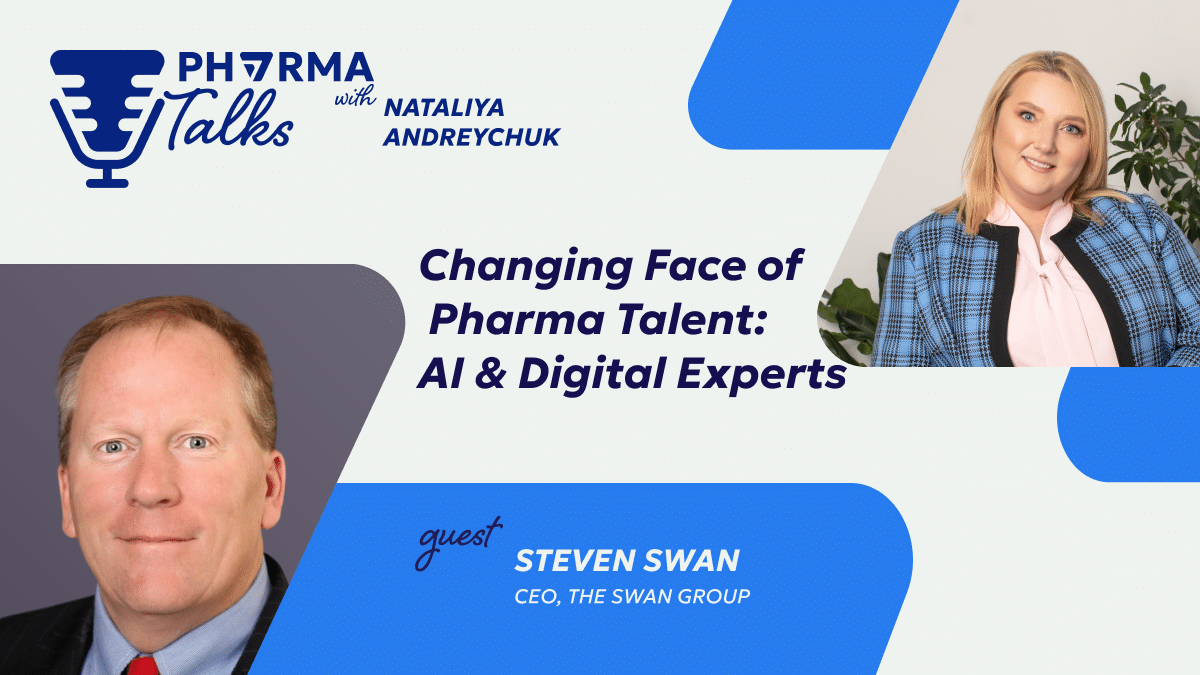
In this episode of Pharma Talks, Viseven CEO Nataliya Andreychuk spoke with Steve Swan, CEO of The Swan Group Executive Search Firm, who has spent 26 years placing IT professionals into pharma and biotech.
Steve’s early positioning was that his firm would take on any tech work biotech companies needed. “Be careful what you wish for,” he joked — technology now touches everything, and the business side is as involved with AI as IT is. A useful calibration from his client base: a “small” company in this industry can carry a billion-dollar valuation and a thousand employees.
Mission as a Recruiting Argument
The case for AI expertise in life sciences is straightforward when you look at the timeline. Compound discovery, years of experimentation, data collection, clinical trials — automating even fractions of that saves real time. Cutting a development timeline from ten years to nine changes the economics for a company and the wait for a patient.
The difficulty is what pharma can offer against tech-sector compensation. The people who come are generally motivated by the work itself rather than the package, and Steve is direct that this filters the candidate pool.
Underneath all of it sits data quality. Steve calls clean, standardized data “the gasoline for the engine.” Even vendor-supplied data needs cleaning, and in pharma the FDA sets the tolerance at zero.
Automation, Layoffs, and What They’re Actually About
Nataliya raised the restructuring wave — Novo Nordisk announcing roughly 9,000 job cuts, about 11% of its workforce, as part of a focus on diabetes and obesity — alongside reduced public health funding. Talent is leaving the industry while companies simultaneously hunt for AI expertise.
Steve’s read is that automation is the low-hanging fruit and is already being adopted across experimentation, clinical, sales, and marketing. He’s working with two companies actively shifting toward it now. But he doesn’t see mass displacement following from it.
“I think we’re a bit ahead of ourselves,” he said. His own measure of the pace: a few years ago most biotechs had one or two AI use cases. “Last Christmas, it was eight.” AI “is here to stay,” but because everything in pharma touches a human life, every process needs validation inside strict guidelines. “We can’t afford to miss anyone.”
The Role Nobody Had a Name For
Titles cycle — business analyst, business manager, and now business partner. Steve thinks this one is different in substance rather than just naming.
The business folks don’t want to talk bits and bytes all day. They want someone who really understands their world. At the same time, IT teams need someone who can speak their language and grasp the business context.
The person who works is fluent in both. They translate, shape the roadmap, and set priorities because they know what the business wants and what IT can actually deliver. “They’re embedded in IT but sitting at the strategy table,” Steve said.
His framing of how these people treat AI is worth noting: not as the organizing theme of the job, but as one tool among several. “It’s not about making AI the whole theme. It’s part of what they do.”
Where AI Recruiting Breaks
Some organizations, in Steve’s phrasing, “have gotten out over their skis” — assuming AI can absorb most of what a recruiter does.
AI can help make people more efficient. It can identify candidates and even help find some of the right profiles. But there’s still a big gap in the middle of the process — the human understanding part.
Sourcing and offering are the visible ends. The middle — qualifications, personality fit, whether someone will actually work inside a particular culture — is where searches succeed or fail. “Just AI scanning résumés isn’t enough. You still need interviews, real conversations.”
The evidence shows up in outcomes. Steve used to see roughly one declined offer a year. He now hears from multiple companies with candidates walking away or processes stalling after months. “It’s because none of the work in the middle is being done.”
His own method is continuous contact with both sides — knowing at any point what’s a yes, a no, and a maybe. “If I don’t have all these things, then I’m not helping the company or the candidate.”
Hybrid Roles Are Already Here
Nataliya’s observation is that the industry is moving away from siloed job definitions toward positions that combine business understanding with technical fluency. “AI & data is the new gold,” she said. “Those who really understand their data are the ones who will win — because they can make data-driven decisions and behaviors.”
Steve confirmed the pattern from the hiring side, and dated it:
The first time I had a marketing opening that combined commercial and medical expertise was probably back in 2016. At the time, it was pretty unique. But now, that kind of hybrid role is becoming increasingly common.
Smaller organizations get there faster, partly out of necessity. “Because of their size, they have to push some roles together.” He reads that as a preview of where the whole industry lands — digital, scientific, and commercial expertise working as one function rather than three.
Hot or Not
Nataliya closed with a lightning round — short statements, immediate verdicts. Steve’s calls:
Not — pharma layoffs are less about cost-cutting than about making room for digital talent.
Hot — hiring ex-Big Tech engineers as a shortcut to accelerate AI transformation.
Not — AI making the classic medical rep role obsolete.
Hot — remote-first pharma teams out-innovating in-house ones.
Hot — regulatory red tape keeping top AI talent away.
Hot — digital-native startups outcompeting traditional pharma for AI experts.
Hot — pharma poaching digital pros from gaming and social media.
Hot — a surge in “Chief AI Officer” roles over the next five years.
Hot — AI talent demanding startup-style equity, and pharma having to say yes.
The two “nots” are the interesting ones. Both push back on the assumption that AI is displacing people rather than repositioning them — consistent with everything Steve argued earlier about the middle of the process being where the human work lives.
Final Words
The through-line of the conversation is that pharma’s talent problem isn’t really a sourcing problem. Candidates exist. What’s scarce is the ability to identify who will function inside a specific organization, and that judgment doesn’t automate.
The same logic runs through the roles themselves. Business partners exist because translation between IT and commercial requires someone who genuinely understands both — a capability that has to be hired for, not installed. As those hybrid roles spread and the lines between digital, scientific, and commercial expertise blur further, the organizations that do well will be the ones treating that middle ground as a discipline rather than a gap.