Why change something that works? It’s a fair question in an industry built on validated systems and strict regulation. The harder question is whether “works” is being measured against today’s conditions or the ones the process was designed for.
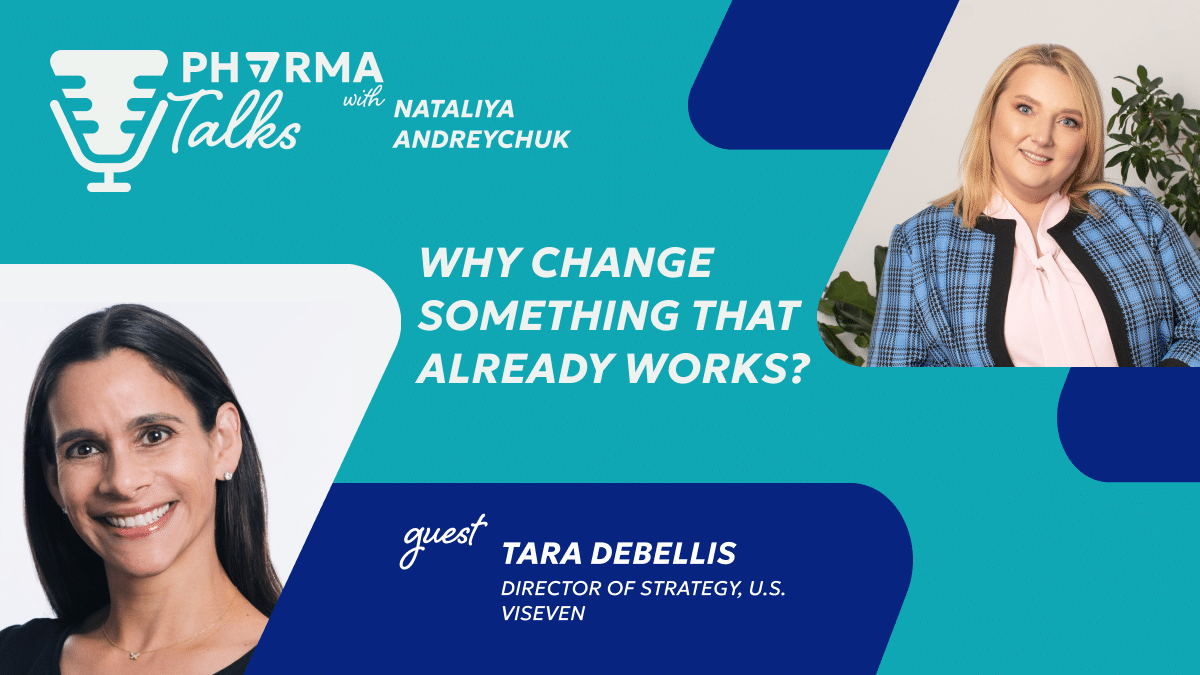
In this episode of Pharma Talks, Viseven CEO Nataliya Andreychuk spoke with Tara DeBellis, Director of Strategy at Viseven USA, about telling real need apart from trend-chasing.
Reading the Signals
Tara’s starting position is that the evaluation itself matters more than the answer.
We are in the age of technology and AI, and this is not a static industry – things are always changing. We don’t want to chase pharma trends just to get on the bandwagon. Instead, I would say that looking at organizational processes, analyzing what’s changing, and what’s not – how decisions flow and how the business operates – is of utmost importance.
She points to an underused trigger: cost-cutting cycles. They happen annually whether or not anyone frames them as transformation, and each one is an opening to re-examine how work actually flows.
Later in the conversation she gets specific about the warning signs. KPIs flat despite rising content output. Teams dependent on manual coordination to keep things moving. Assets sitting unused because nobody knows they exist. Vendors re-briefed repeatedly on the same campaign logic. Each one is inefficiency showing up as a symptom.
Why Standing Still Is Its Own Risk
Nataliya’s framing is that today’s changes trace back to how customers have changed, not to technology for its own sake. Patients now consult AI before they consult a physician, which alters what “being findable” means.
The practical consequence is structural. SEO assumed a search box; AI-driven indexing — sometimes called GEO — matches questions to answers differently. Content built around professional headlines about a treatment performs differently than content structured as the questions people actually ask.
Tara’s counterweight is that the fear of disruption is legitimate. In pharma, processes aren’t just operational habit — they function as regulatory guardrails, and caution around them is rational.
Her distinction is the one that resolves it: stability is not sustainability. A process can work today and still be unready for the next phase of engagement, particularly as HCPs and patients expect more touchpoints, more personalization, and faster response.
Two Myths About AI
Resistance to change is normal, professionally and personally, and Tara treats it as a starting condition rather than an obstacle. What shifts it is demonstrating how AI actually works — and that the outcome is reallocated time rather than removed roles.
Awareness helps bring us closer to adoption. When we are implementing change, it sounds easy when speaking about it, but when it comes to larger companies, with siloed teams, it becomes challenging. I also think that changing how we work is part of this transformation. In some ways, the incorporation of AI will change how we work. I would say some of these concerns are misconceptions, and many of them can be eased with the right level of communication and the right partners.
Three Myths About Transformation
Nataliya added a second set, aimed at how transformation gets scoped:
It’s about new tools. It isn’t. Real change reshapes how teams work together — process, reuse, cross-functional orchestration. Layering tools on top of an unchanged structure produces an unchanged structure with more licenses.
It’s an IT project. It’s an evolution of marketing operations, with digital as the enabler rather than the destination. Not a project with an end date — a continuous state that transforms things incrementally.
Efficiency equals automation. Efficiency comes from intelligent orchestration. Speed matters less than cohesion.
She also noted a change in what audiences will absorb. Podcasts used to run an hour; attention now measures in seconds. Meeting that requires a content engine capable of producing personalized material at short formats — not a tool, an ongoing capability.
Problem First, Then Solution
Tara’s filter for cutting through buzz is simple: start with a clearly defined problem. Technologies adopted without one rarely produce progress, and the noise makes it genuinely hard to identify what will help.
Nataliya’s version is blunter, aimed at products that add an “AI sparkle” without thinking through the outcome:
You push the magic button, and then you’re disappointed because it’s not what you expected. In reality, today’s AI is still evolving, and the promise of saving time comes with a great deal of background work.
Her related point: tools that perform well in isolation still underdeliver when the systems around them are disconnected. Value comes from connecting technology to a broader knowledge base.
Making It Stick
Willingness to learn is the precondition, and Tara notes that failures tend to teach more than success stories do.
Communication carries most of the weight, and siloed teams make it hard. A clear roadmap with real timelines sets expectations from the start. She uses WIIFM — what’s in it for me — as the framing test: marketing, digital, and IT all have different priorities, so the same change needs to be explained three different ways.
Preparation is the underestimated stage. The pre-pilot work behind any polished AI project is substantial, and without stakeholder alignment done early, projects stall regardless of how good the technology is.
Nataliya’s addition: the initiatives that land usually begin with co-creation. Building alongside teams rather than for them surfaces things you wouldn’t have found otherwise, and makes adoption far more likely.
The Takeaway
Change doesn’t require a complete overhaul. Evolution often outperforms disruption, and the right approach adapts to where an organization actually sits on the maturity curve.
Pharma’s own history supplies the cautionary examples: content hubs built at expense and never used, automation deployed without human context, opportunities missed because no team could see what another was doing. The pattern underneath all of them is the same — transformation without adoption is a wasted investment.