McKinsey puts the failure rate for digital transformation initiatives at 70% across industries — projects that don’t meet their stated objectives. Pharma’s regulated environment makes the path harder, not easier.
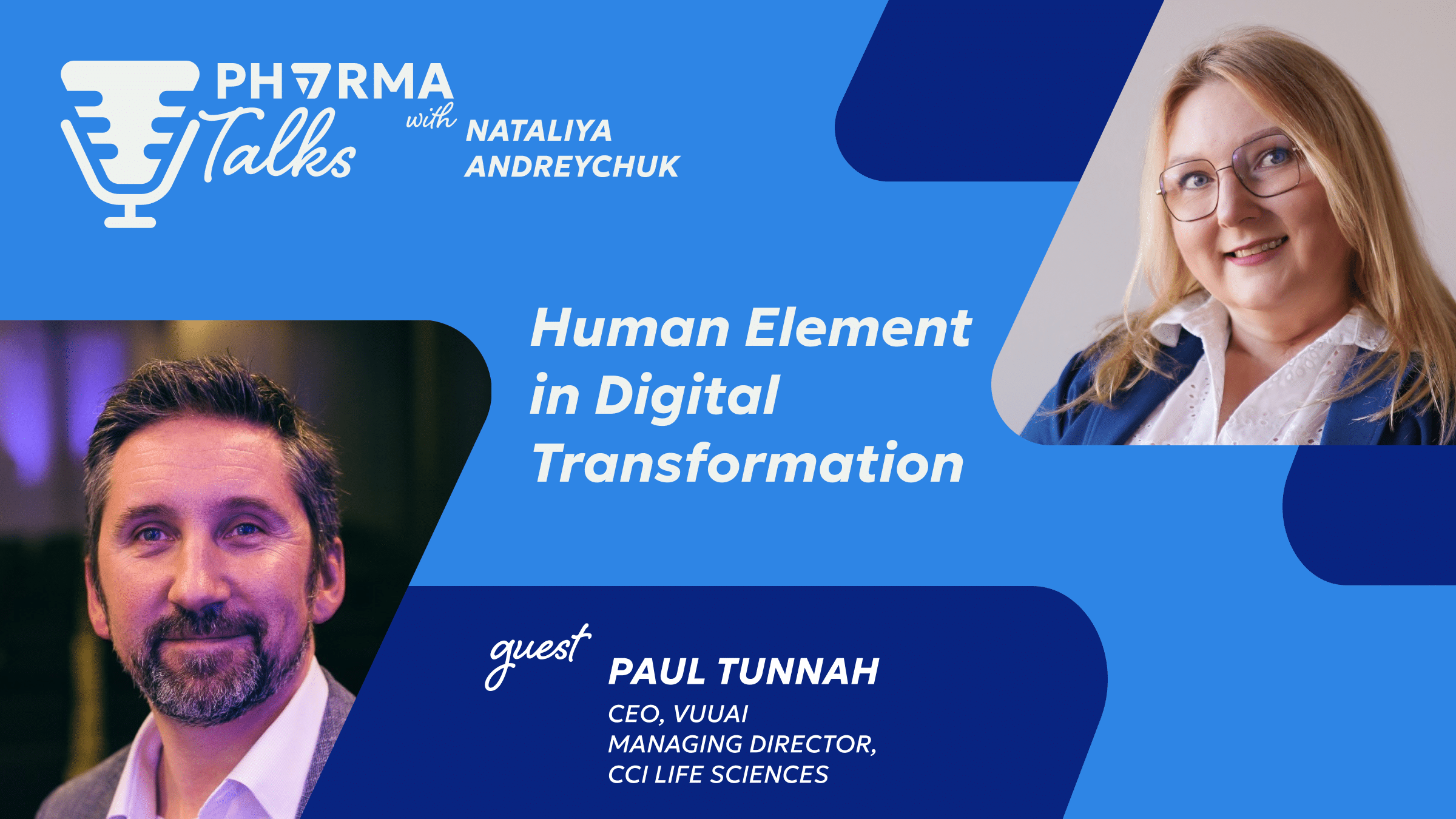
In this episode of Pharma Talks, Paul Tunnah — founder of Pharmaphorum, healthcare communications expert, and co-founder of View AI — argues that most of those failures are preventable, and that the preventable part isn’t technical.
He opened by objecting to the framing itself:
I feel a bit allergic to the word digital. People get obsessed with technology, channels, and all that, but transformation is broader. It’s about people and how companies operate.
The Word That Gets Ignored
The first word in “digital transformation” points at technology. The second points at people — and it’s where the work actually happens: how ways of working change, how mindsets shift, what skills get built.
Which explains the pattern of organizations adopting innovation without sustaining it. Enormous effort goes into selecting and implementing a technology ecosystem; the people component becomes an afterthought.
Teams resist when they don’t see the value, don’t understand the context, or lack support. When global and local aren’t aligned, the change reads as a top-down decision that made the work different without making it better.
The root of it is a sequencing error. Discussions start with technology — shiny tool syndrome, where attention goes to selecting platforms before anyone has defined the problem. The order that works: understand what change is required, then determine how technology supports it. Talking about models, copilots, and automation without a clear picture of how they help teams work better doesn’t produce anything.
Caution Has Its Own Cost
Concerns about AI security and compliance are legitimate, and ignoring them would be irresponsible.
But focusing exclusively on them produces its own outcome — inaction that eventually creates the exposure it was avoiding.
There’s risk when adopting any new technology, but there’s also a reward. If AI helps solve a problem in collaboration with people, the upside is huge.
His reminder for conservative organizations: “If your competitors are adopting new technologies and you’re not, that’s a risk too.”
The workable version is responsible adoption with cross-functional ownership. Decisions about what to share with AI models and what to protect shouldn’t sit with one function.
It’s about understanding what’s unique to your company versus what’s generic. These decisions should involve IT and business leaders together, because they understand both security and downstream application.
Evolution, Not Revolution
AI coverage arrives with a visual grammar of disruption — blue screens, robotic hands, futuristic imagery — which reinforces an expectation that adoption happens fast.
Asked whether AI in CRM and customer engagement is revolution or evolution, Paul didn’t hesitate: “I’d say evolution. Technology moves fast, but data, workflows, and people take time. Systemic change is gradual.”
Expecting entrenched habits to shift quickly isn’t impossible so much as improbable. What produces results is continuous change management that embeds technology into real workflows and gives teams a reason to use it.
He describes the resulting state as perpetual beta — tools evolving, processes adapting, organizations learning continuously. His practical conclusion from that: “Big companies shouldn’t try to build bespoke systems. It’s better to partner with experts who are constantly improving the tools.”
The Data Problem Is Abundance
Looking toward 2026, Paul’s read on engagement is that people are already saturated. Companies respond by adding channels when the constraint is quality, relevance, and trust.
The assumption underneath most personalization efforts is that data is scarce. Usually the opposite is true. Customer feedback, social listening, real-world evidence, years of engagement history — it’s already there, and gathering it into one place is where the difficulty becomes visible rather than where it resolves.
Personas aren’t static. Start with segments, optimize dynamically, and make sure field reps have the right materials to engage effectively.
The analogy that follows is apt: a clinician interprets complex data to guide one patient. Field teams need the same kind of structured guidance to adapt content to the interaction actually in front of them.
Feedback, Not Dashboards
Effective engagement looks effortless and almost never is. Nataliya’s example was the amount of preparation hidden behind anything that appears simple.
Paul connected it to how ecosystems should be built:
Our ecosystems must provide feedback. Learn and adapt. Dashboards alone aren’t enough. And don’t get lost in big data. Maintain the human connection.
Hot or Not
Short prompts, quick reads on where things are heading:
Generative AI producing 70% of pharma content — “Not yet. People factor still matters.”
Commercial and medical teams building content together — “Hot. It’s happening.”
Hyperpersonalization versus strong segmentation — “Hot. Fix segments first before chasing n equals one personalization.”
Replacing channel mix thinking with story architecture — “Hot. Focus on story, not just channels.”
Final Reflection
Transformation is a change in how teams think, work, and learn. AI is the tool that supports it, and as the technology matures it will become more capable and less visible — working in the background the way a good interpreter does, enabling the conversation without becoming part of it.
The condition Paul returns to throughout: it only sticks when it makes sense to the people doing the work, and to the people the work is meant to serve.