The investment is real. The results are hard to locate. In the worst cases, teams can’t establish whether HCP engagement has improved at all.
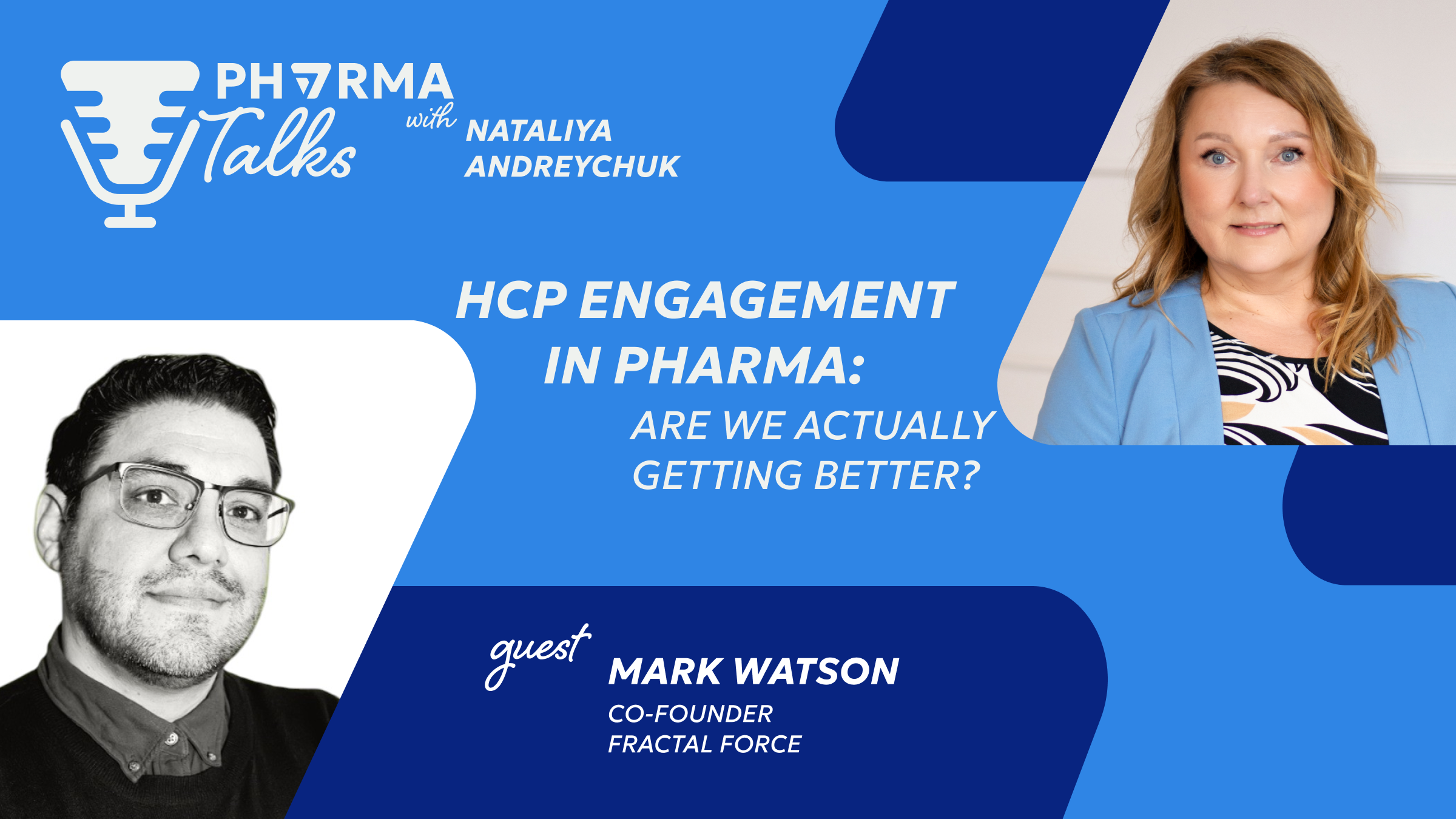
In this episode of Pharma Talks, Mark Watson, Co-Founder of the independent consultancy Fractal Force, argues that this isn’t a failure of effort.
Built for Broadcasting
“It’s not a people problem. It’s not even an investment or effort problem. It’s often an architecture problem.”
The foundations underneath pharma HCP engagement were designed for a different job: getting a message to as many people as efficiently as possible. Not listening. Not responding. And no new platform layered on top changes what the layer beneath it was built to do.
The symptoms follow from that. CRMs capture activity — what was done, when, how often — without asking whether it was the right thing to do or whether it landed. Segmentation personas exist “beautifully within a slide deck” while nobody verifies whether a given HCP is actually on the right journey. Annual planning cycles impose fixed paths on relationships that change continuously.
And because omnichannel KPIs are built around activity — did we use the new channel, did we get people to congress — teams end up measuring what flatters them rather than what would tell them something.
HCPs don’t see themselves as persona X or persona Y. They have their own specific needs, questions, understandings and preferences.
Design a rigid journey and it works for the small minority who happen to follow it. For everyone else the system has no response — and because nobody measures whether the engagement meant anything to the individual, the failure never registers. So it runs again.
Volume Was Never the Constraint
Companies are expected to produce large volumes of personalized content across therapeutic areas, personas, and localizations. The production and regulatory load is genuinely heavy, AI notwithstanding.
But Watson’s point is that the bottleneck sits elsewhere. Between content factories, AI, and service providers, volume can be solved. MLR capacity can’t be expanded the same way — which makes prioritization the actual question. What is genuinely going to make an impact?
That points toward intelligent content design, which is a set of questions rather than a process: who are we speaking to, why, what should we say, and what do we want them to think or do differently?
Strategic editorial calendars matter here for an unglamorous reason. Knowing what’s happening and when lets content be aligned to MLR windows, so material clears approval in time to be useful — before a webinar, after a congress, at the moment it’s relevant rather than whenever it emerges.
“More is not better until we understand what we’re doing and why we’re doing it.”
When content can’t carry the strategy, Watson reads it as a signal about something upstream. “It’s not the content itself that is the problem.”
What Good Looks Like
Watson has seen this work in “small little pockets,” and the difference always starts with the customer.
When a rep or MSL opens a conversation, they need a real understanding of where that HCP sits in their diagnostic and treatment world — what they’re engaged with, what they think, what they want, and where they’re starting from attitudinally and behaviorally.
That’s what prevents starting from zero every time, or falling back on “it’s week six, so it has to be message number four.”
From the HCP’s side the difference is substantial. Trust gets embedded, and they’re more likely to engage, follow up, ask questions, and return — because it starts functioning as a conversation.
The mechanism underneath is a loop: engage, observe what happened, learn from it, adapt, repeat.
Digital channels can’t hold a conversation on their own. But content built to make sense in context — because the HCP asked for it, because it follows the discussion they just had, because it picks up from the webinar they attended — becomes part of one.
Order Matters
For organizations already mid-transformation, Watson’s central point is about sequence.
The journey logic has to exist before you start building the content.
That means the narrative comes first. What story are we telling? How does it break into pieces that flow naturally across channels, timelines, and segments?
The measurement framework has to be designed and deployed before content ships. What is this email meant to achieve? Why are we inviting people to this webinar? What does a meaningful response look like?
Without that, execution becomes what Watson calls “launch and hope.” His alternative: “We need to understand what we think is going to happen and then measure whether it really does.”
Pause Before Adding
For teams already committed to platforms and processes, his recommendation is to stop before adding another channel, service, or piece of content.
I know that’s the hardest thing to do. We often talk in pharma about fixing the wings whilst we’re already flying. So, pressing pause seems very dangerous. But just pause and take a breath and really define what working looks like. Not at the activity level, not in terms of volume, not in terms of ticking a box, but at a genuine behavioral level. What are we trying to get our HCPs to do differently, to think differently, or to believe?
Teams that can answer that find the rest follows. Teams that can’t won’t fix it with a new channel. “If you don’t know what you’re really trying to achieve, what is launching a new channel or a new bit of content actually going to do for you?”
One Question Worth Asking
Watson closed on the Pareto principle. The top 20% of an HCP audience represent the most important relationships a commercial team has. His question for every commercial leader:
For that top 20%, can you say, hand on heart, from actual data, not gut feel, not what the sales director said, not from marketing, whether they are more engaged and have improved their behavior in the direction you want, compared to last quarter, last cycle, last year?
If the answer is yes, keep going. If it’s no, the work isn’t another channel — it’s establishing whether there’s a genuine strategy behind how content goes into the world, or whether things are happening because they’re the things that happen.