Almost every pharma team is running AI experiments. Very few have been changed by them. The difference usually traces back to a sequencing decision made early.
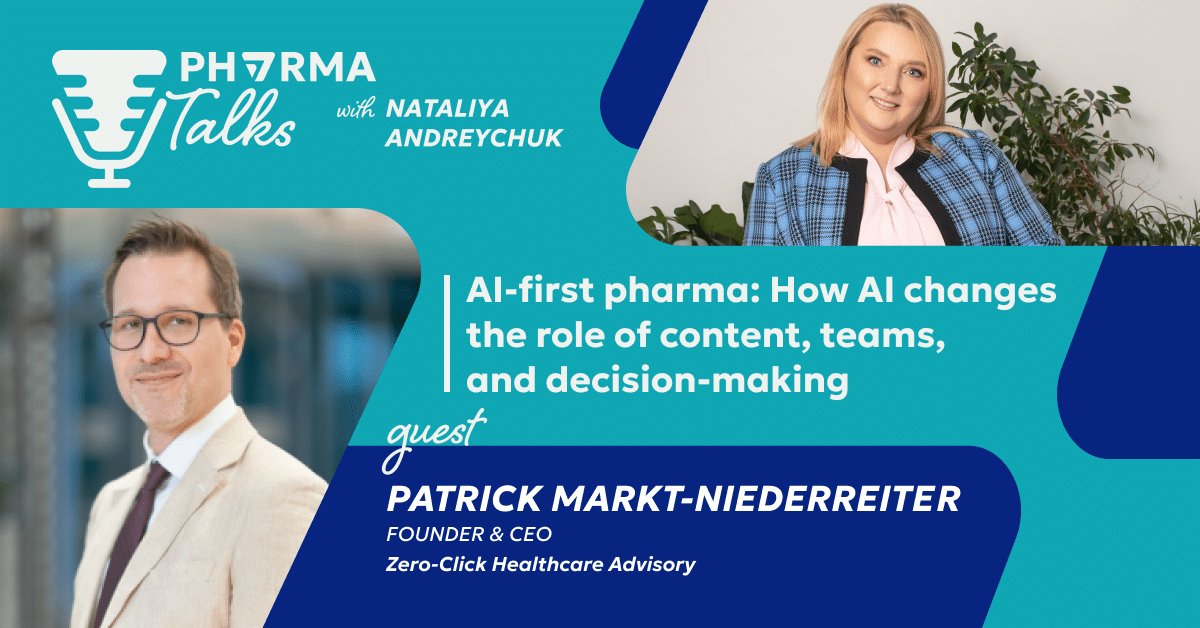
In this episode of Pharma Talks, Nataliya Andreychuk, Co-founder and CEO at Viseven, and Patrick Markt-Niederreiter, Founder and CEO of Zero-Click Healthcare Advisory, work through what an AI-first model actually asks of an organization.
The Sequencing Problem
The common pattern: a team decides what it wants to do, then asks how AI can help. Patrick calls this AI-last. It works — you get faster summaries, automated KPI tracking, optimized versions of workflows you already had.
AI-first inverts the order. “You start by asking: what can AI do exceptionally well, and how do we build workflows around that?” Patrick explains.
The difference shows up in what becomes possible. Instead of reading dashboards, a system surfaces where campaigns are over- and underperforming and proposes discussion points from the deviations it found. Instead of building a segmentation model manually and automating pieces of it afterward, you reconsider the process entirely — which is how Patrick’s former team took KOL segmentation from two months to one minute. Machines handled the automation; humans kept the judgment.
From APIs to Agents
The shift underway is from systems exchanging structured calls to agents that act, suggest, and coordinate.
Personalization used to require stitching disconnected processes together. The current question is what end-to-end looks like when agents handle the connective work.
“One agent suggests audience segments. Another searches your DAM to find matching content. Another simulates how your target doctor will respond. And this all happens in minutes, not months, if you have templates and design system ready, of course,” says Nataliya.
That final clause carries more weight than its placement suggests — the speed depends on foundations already being in place.
Output Metrics Are Measuring the Wrong Thing
“We’re still obsessed with output metrics: 10% more emails sent, 15% more assets created. But do customers really want that?”
Patrick’s alternative is insight-to-act time: how quickly feedback becomes validated change. A campaign underperforms — the question isn’t whether it was logged, it’s how fast it was fixed.
“We’re cutting the distance between seeing KPIs and acting on them,” says Nataliya. In a regulated industry, that distance is both more critical and harder to close.
Test Small, Scale What Works
Audiences have stopped tolerating one-size-fits-all, in pharma as everywhere else. Micro-experiments are one route out: run small, scale what performs.
There’s an organizational benefit beyond the results. Under top-down content models, stakeholders spend significant energy persuading each other that an approach is right. With evidence from real tests, the persuading isn’t necessary — the case is already made.
You find your way out of the jungle by walking through it. Micro-tests make it a safe one to walk.
Where the Technology Should Get Out of the Way
Nataliya’s framing of what a platform should do: let medical and marketing teams focus on their next move rather than on execution mechanics. Click, drag, drop — no requirement to be AI-literate, and no requirement to be a developer.
She’s also direct that tech providers shouldn’t try to own innovation. The average customer runs operations across dozens of platforms; a campaign might begin in one system, segment in another, and produce content in a third. Connecting those is a collaboration problem, not a competitive one.
Patrick’s Closing Advice
Good technology doesn’t demand that you understand what’s happening under the hood. It asks you to be clear on the essentials instead: what campaign are you running, who is the audience, what are you trying to accomplish. Precision on those questions is what determines the quality of what comes back.