Handing AI tools to people who don’t know how to use them can lower performance rather than raise it. That finding reframes what an AI budget should actually buy.
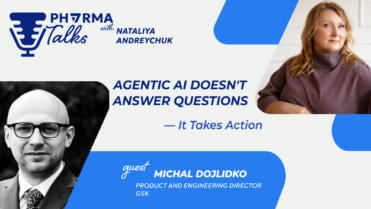
In this episode of Pharma Talks, Nataliya Andreychuk spoke with Thomas Mrosk, Founder and Managing Director at ctcHealth, and Manuel Mitola, Partner and Head of AI Consulting at ctcHealth, about AI literacy and what it takes to get value beyond the obvious tools.
Two Ways Companies Use AI
Thomas splits it simply: to boost productivity, or to enhance intelligence.
His preference is starting small. Organizations are increasingly investing in the infrastructure to access large language models, often through platforms like Microsoft, which opens the door to agents that absorb routine tasks and reduce manual load. That’s where he sees the strongest near-term potential.
Manuel’s framing is the agentic approach — AI deployed for clearly defined purposes. “This essentially means creating small, specialized AI teams to handle specific tasks. In an industry like pharma — where precision and specialization matter — this approach is especially powerful.” His read on adoption is that tools like Copilot and custom GPTs are getting noticeably better reception than they were a few months earlier.
On the intelligence side, both point to the same strengths: analyzing large volumes of data, surfacing perspectives that weren’t visible, and taking on work people find tedious.
Where They Push Back
Asked whether agentic AI might end up handling most of the work — social listening, cross-channel interaction analysis — Thomas was cautious. He doesn’t subscribe to the version where AI handles nearly everything, and his reason is domain expertise.
Rather than replacing humans, AI currently serves to augment their work. We’re guiding AI agents, not just handing over control. This has significant implications for workforce planning and the kinds of capabilities organizations need to build.
What Makes an Agent Useful
Manuel’s observation is that LLM output is sounding more natural, and that the value shows up in productivity and customer experience. What he finds most promising is access: “the possibility for people without technical or development backgrounds to use their domain and industry knowledge to build solutions powered by AI.” No-code platforms for building agents put capability where the subject knowledge already is.
Thomas takes it toward the human side of adoption:
Humanization becomes even more visible as we start interacting more regularly with AI agents. The way we handle training and change management is about to shift dramatically. These agents aren’t just useful because they’re smart. They create a safe, always available, and increasingly personalized environment for users. This opens up unprecedented support for the workforce.
His marketing ambition is hyper-personalization — right customer, right content, real time — which he expects to become standard within about two years.
He’s also clear about what that creates. Content production scaling by 10x or 100x makes MLR the binding constraint, which means the same tooling has to work on the compliance side. “In this context, AI won’t just accelerate marketing — it will help manage compliance too.”
Nataliya’s qualifier: with technology moving week to week, strategic clarity is what prevents the overwhelm. A company that picks one target — accelerating clinical trial documentation, say — can see results in months rather than years. And content creation is no longer separable from MLR, since tools already handle claims, references, and compliance checks inside one workflow.
If the Budget Doubled
Nataliya’s question: if your marketing budget doubled tomorrow but could only be spent on AI, where would it go?
Manuel’s answer went to literacy first, and his reasoning is the sharpest thing in the conversation.
There’s research suggesting that if people use AI without knowing how to use it properly, their performance can actually decline. One of the biggest mistakes organizations can make is giving AI tools to employees who aren’t prepared to use them. Instead of boosting efficiency, this can have the opposite effect.
So the money goes to training and education, because the return comes from the combination of people and tools rather than from either alone.
Thomas would go further on the amount — triple or quadruple rather than double — while landing in the same place on sequencing. Millions spent without alignment and training won’t produce results.
He adds change management as the piece that gets underestimated. There’s a generational dimension: some employees are more comfortable with new tools than others, and the ones who need more time need support rather than pressure.
Closing Thought
The pattern across both answers is that AI investment is really two investments, and the order matters. Capability without literacy produces worse outcomes than no capability at all — which is a counterintuitive enough finding that it should change how these programs get funded.
Nataliya’s closing framing: “High-performing businesses are focused on one thing: improving outcomes and giving humanity a better chance to thrive.”