“Content strategy” has been said enough times to lose most of its meaning. What hasn’t changed is that campaigns with one behind them perform differently than campaigns without.
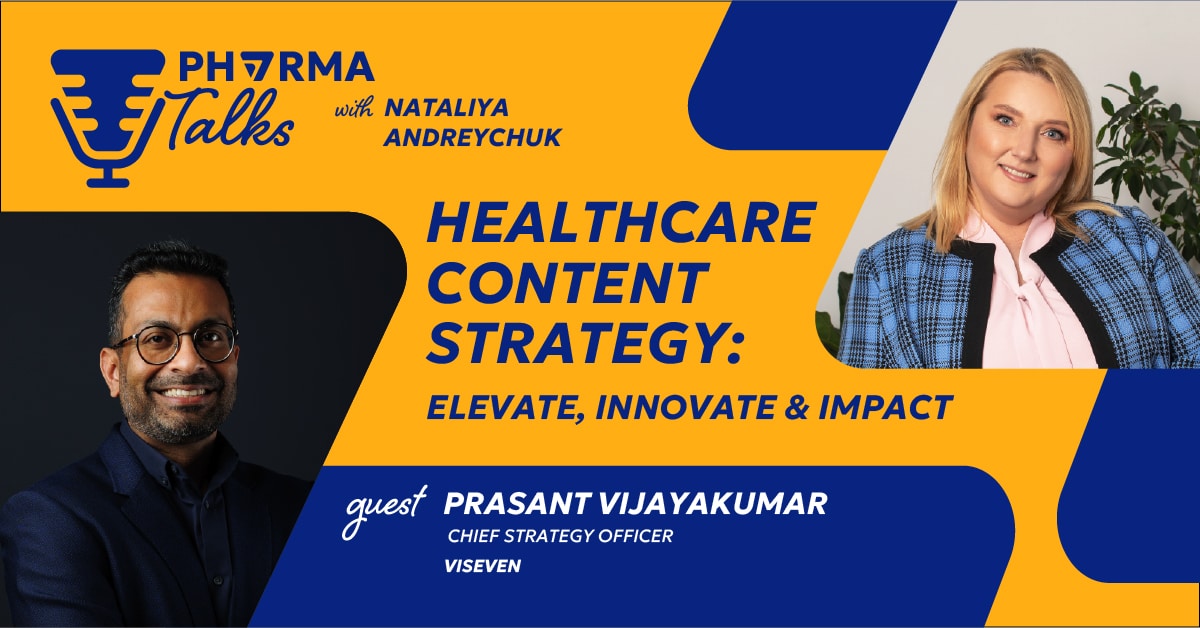
In this episode of Pharma Talks, Nataliya Andreychuk, Co-founder and CEO of Viseven, spoke with Prasant Vijayakumar, Chief Strategy Officer. Prasant’s nearly 20 years in the industry started with pharmacy and medical rep work, moved through content creation and agency side, and has landed on digital transformation — with modular content running through most of it.
Why Strategy Matters More Now
Content strategy in pharma isn’t new; it’s been part of branding and product launches for a long time. What shifted over the last five to ten years is the emphasis. Digital transformation pushed efficiency and standardization to the front, because those are what make scale possible.
Pharma content has always been constrained by regulation. You can’t create and publish freely — there’s a process. A clear strategy shortens that process, cuts duplication, and gets material to HCPs and patients faster.
The core advantage is standardization: repeatable ways of working that stay compliant. As Prasant frames it, the challenge in pharma isn’t daily output volume. It’s what you’re permitted to say about efficacy and safety, and how you say it.
The Shift from Commercial to Medical
Attention has skewed commercial in recent years — visuals, creative, how things look. Medical content needs the same strategic treatment, and it starts earlier.
Prasant’s point: content begins well before launch. A published paper is usable content the moment it exists. Those early medical materials can be adapted for commercial use later, which means a real content strategy starts pre-commercialization and reuses approved material across the full product lifecycle.
On “Retiring” Modular Content
Prasant rejects the framing outright. Modular content hasn’t failed — it’s been under-defined, with too many competing definitions circulating for the industry to adopt it properly.
The persistent misread is treating it as something technology will solve. Going modular is a strategic decision that takes planning before it takes tooling.
It’s also not an all-or-nothing commitment. The original idea was to identify the key messages you need to carry across channels and formats, then standardize those core elements. New content still gets made — that’s what creative agencies are for. Modular just means you stop rebuilding what already exists.
Standardize the Reusable, Not the Outdated
There’s a failure mode where modularization becomes a way to recycle old material. That’s the wrong intention.
“One of the key shifts in focus for creative agencies should be developing meaningful content,” Prasant said, “not just presenting the same old messages in a completely new design, as it is a waste of time and effort to focus on just past content.”
Alignment Before Implementation
“Before implementing modular content, it’s essential to ensure strategic alignment across the organization,” Prasant said. “For example, suppose you decide to establish a Center of Excellence for content operations. In that case, there needs to be a clear reason behind it, such as improving efficiency and reducing repetitive, transactional activities that often lead to wasted effort.”
The payoff is message consistency across a product’s lifecycle — plus a feedback mechanism. When content stops engaging, modular structure makes it possible to see what to change rather than starting over.
Starting From Wherever You Are
You don’t need a clean slate. If the internal groundwork exists — you know your segments, their drivers and barriers, and the messages you need to land — the next step is auditing what content you already have, then identifying which modules are missing.
“After that, it’s simply a matter of determining how to reach your audience: which channels to use, what formats, and which templates — many of which can be standardized and used across markets,” Prasant said. “Once markets begin using these templates, it becomes a plug-and-play process.”
That builds a global-to-local ecosystem connecting creative agencies, in-house studios, and cross-functional teams on a shared platform — a different model than the resource-heavy production setups it replaces.
What AI Actually Needs From You
“The overall pharmaceutical content strategy isn’t likely to change, because AI is ultimately an enabler, not a replacement,” Prasant explained.
His argument to clients: if you want a system AI can learn from, modular content is where to start. Training requires structured data, and modules — discrete pieces carrying single key messages — are exactly that. Start using modules now, and you generate the training data later automation depends on.
The endpoint is AI auto-assembling assets in the right format for any channel, once the content strategy underneath it is sound. Getting there requires the foundation first.
Where to Begin
“The most important thing is to have a proper content marketing strategy,” Prasant advised. “Don’t try to build everything at once — Rome wasn’t built in a day. Take it step by step. Always start by creating a prototype, test it, learn from it, and then move on to the next stage. This applies to modular content as well.”
Don’t aim for 100% modular out of the gate. Standardize what you already have, which gives you a reliable base, and keep creative capacity for the content that needs to stay fresh.
The closing advice from both speakers: know what you want to do, understand why you’re doing it, start small — and only then think about scale. team.