Retail wrote the omnichannel playbook in the early 2000s. Pharma arrived much later, and to a harder version of the problem — one where the output affects patient outcomes and the rules from telecom and retail don’t transfer cleanly.
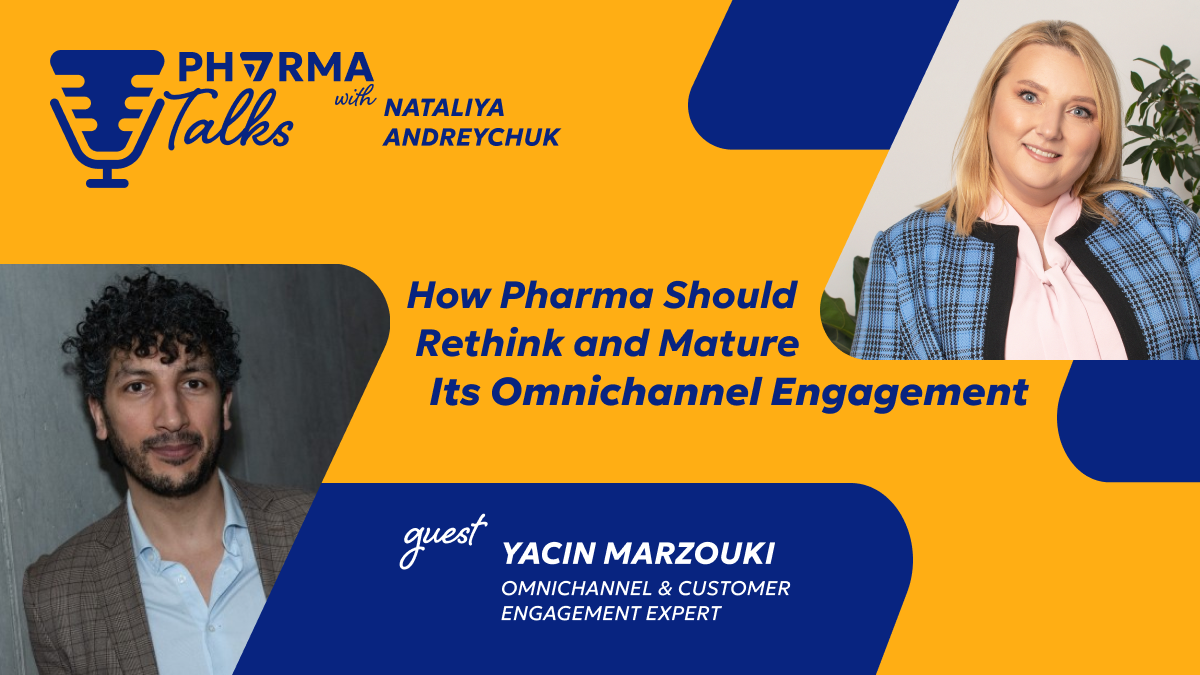
In this episode of Pharma Talks, Nataliya Andreychuk spoke with Yacin Marzouki, who has built omnichannel programs across Japan, EMEA, and South America. He’s launched HCP portals that worked and portals that didn’t, and he’s specific about which was which.
His core position: pharma doesn’t need more channels or more technology. It needs alignment and a real understanding of its audiences.
The Fragmentation Problem
Asked about blind spots, Yacin’s answer starts by rejecting the framing. It isn’t a technology problem.
In retail, one function typically owns omnichannel end to end — the stack, the CRM, content creation, campaign execution, and the insight loop that feeds back into all of it.
Pharma splits that across teams. Marketing creates content without owning the tech stack. Omnichannel teams run the stack without creating content. Analytics sits in its own lane. Medical approves content without being aligned on segmentation goals. Data silos follow structurally, and personalization gets harder as a result.
The second blind spot is more fundamental:
In life sciences, we need to get clear on who the actual customer is. We obsess over what HCPs supposedly want. But HCPs don’t make decisions in a vacuum. They manage institutional pressures, payer rules, and patient anxieties. If we don’t equip them with the information they need to convince patients, our content delivers zero real value.
The third: teams collect data, interpret it separately, and never consolidate it into one narrative. Which leaves marketers without a reliable basis for deciding what to do next.
Faster Horses
Plenty of brands describe themselves as customer-centric while doing something narrower — asking the audience what it wants without understanding the situation the answer comes from.
Yacin’s argument is to stop asking HCPs what they need. It’s the 1900 question about faster horses. The useful questions look different:
- Where do they actually access information today?
- What problems are they hitting with patients?
- What are they searching for?
- What questions do patients keep bringing them?
The reframe underneath all four: the job isn’t only convincing HCPs. It’s giving HCPs what they need to convince patients, who are making the decision.
What Maturity Actually Looks Like
Omnichannel has a definition problem. People picture the end state — right message, right time, right channel — and treat that as the strategy. It’s the outcome.
Yacin’s stages run from face-to-face only, through basic activation with a few added channels, to multichannel, then omnichannel, then advanced or predictive omnichannel.
Multichannel gets dismissed unfairly. Executed well, it works. Nataliya’s own approach is the example he reaches for — audience trust built across channels over time, with the podcast added once the foundation existed.
The podcast isn’t fully integrated into your ecosystem, and you can’t track whether Dr. Anna watched it for 30 minutes. But that’s completely OK. It still delivers value. And when you consistently deliver value, you earn the right for deeper interactions later.
His point about attribution follows from the same logic. No decision comes from one channel.
I’m sure there were multiple “aha moments” before you, Nataliya, bought your glasses. HCP decisions work the same way.
Why It Gets Expensive
Maturity raises costs on both sides — the stack and the content plan. Segmentation only produces value if you actually make content for each segment.
Five personas and one email is zero personalization. Five personas and five emails lifts engagement, and lifts cost and approval load with it. Medical teams frequently don’t have capacity to clear that volume, which is why the plan has to be built jointly. Otherwise you produce five and ship one.
The Content That Never Arrives
Even approved content stalls. The episode cites 77% of content never reaching HCPs — not because it’s poor, but because reps aren’t comfortable presenting it. Without understanding the persona it was built for, they revert to the deck they know.
Nataliya’s addition:
Segmentation is often too generic. If the content doesn’t match the conversation, it never gets used.
Agencies working without HCP-level data can only personalize at the surface, which is why more pharma companies are building digital personas. But the value of that varies by market. In Spain, where HCP engagement is regular and digital, personas are grounded in something. In Germany, where reps might see an HCP once or twice a year and email open rates run lower, personalization rests on assumption.
Hot or Not
Nataliya’s rapid-fire round, and where Yacin landed:
More platforms equal better omnichannel — Not.
AI will outperform humans in segmentation by 2026 — Hot, but only if real value follows.
Rep-triggered engagement will beat mass email — Hot.
Omnichannel starts with content, not data — Hot.
HCPs want personalization, not promotion — Very hot.
Global should own strategy, local should execute — Lukewarm.
The future is fewer but smarter channels — Hot.
PDFs will disappear by 2027 — “No chance. There are still fax machines in Germany.”
Omnichannel will merge with medcomms and patient engagement by 2030 — Hot.
The next frontier is emotional tech, empathy, and trust — Hot.
Getting It Right
Technology alone doesn’t fix omnichannel. What does is teams sharing data continuously, testing, and checking findings against what they actually know about their audiences.
And the audience isn’t only HCPs. Once that’s clear, the work becomes asking better questions — the kind that come from empathy rather than from an agenda. That’s the shift from treating omnichannel as a department to treating it as an ecosystem.